Tommy Hollenstein’s paintings are alive with color. Vibrant reds and rich blues collide with streaks of yellow like veins of energy. Colors like sunsets or lush abstract landscapes radiate seductively. Some canvases are elegantly stark, while others are dense with layers and rhythm. It’s the rhythm that is captivating. Evoking movement is the painter’s greatest challenge, for the picture is in reality motionless before us. It is the skill and passion of the artist that can cause the surface to appear to dance. Once the viewer is captivated by the dance on the canvas, they are lured closer to inspect the strokes on the surface. With Tommy’s art they will find no brushstrokes at all. There is something else: Patterns laced within patterns and spirals of swirling tire tread-marks. Tommy Hollenstein paints with his wheelchair.
Our culture easily embraces the victim, but Tommy has nothing to offer in the victim-hood department. Instead, he concentrates on his powerful strength and gifts. Without a pause he will tell you that his art is about “Joy and passion.”
Charismatic and handsome, he does not hesitate to talk about the day when at age twenty five, he broke his spinal column in a bike accident that changed his life forever. On March 10th, 1985 when he flew off his bike and hit the ground, he remembered hearing a “pop” like the striking of a metal rod. Then, he remembered floating up into the clouds.
“I was dead”, he says. “I could look down and see my own body laying there motionless. I remember thinking that I was not yet ready to die. I asked God to give me another chance.” When Tommy returned to his body, he knew immediately that he had broken his neck. His buddy called an ambulance, and the seriousness of his injury was confirmed. When he arrived at the hospital a priest gave him his last rights, but Tommy’s gratitude for life surpassed his sense of loss, and he did not die. After six difficult months in rehab, he was able to get movement in his arms and learned how to function as a paraplegic. Tommy would spend his remaining life in a wheelchair.
Of course, being the amazing person that he was, after being discharged he immediately set about living his life to the fullest. Without the use of his legs, he still enjoyed boating and water-skiing. His interest in this dynamic sport led him to even create a special device that Quadraplegics now use to water-ski. This kind of love for other people ensured that he would always be active and social. To be sure, Tommy was not alone in the world. His ongoing journey was enhanced greatly over the ensuing years by physical therapists, family and friends… and also by a dog named Weaver. Weaver was trained specifically to aid Tommy and grew to become his trusted companion. It was through this special relationship that Tommy was led to realize his powerful voice as an artist.
Tommy speaks with emotion as he relates the idea that opened this door. “I knew that my dog wouldn’t always be in good health forever. I wanted to do something to remember Weaver by. Why not record his paw-prints?” He laid a flat surface on the ground in his garage and coaxed Weaver to dip his paws in colored house paint. Then, Tommy rolled through some paint as well.He moved across the flat surfacein his wheelchair as Weaver walked faithfully beside him, leaving paw prints and tire marks on the paper. They tried this together a few times, and during the process Tommy realized that now...he was painting.
“ I tried experimenting with different colors, and patterns. I found that I had really fine control over the sensitivity of my marks,” he states. Indeed, the built-in computer in his wonderful Invacare motorized wheelchair allows him to maneuver with varying speed, direction and pressure as he paints. He was hooked.
A number of dedicated paraplegic and quadriplegic artists around the world have learned to paint with brushes delicately held by their teeth, or with their toes. Their work is incredible in that it is a testament to unstoppable courage , but it also reflects the common drive that so many artists have within them. Learning or relearning a manual dexterous skill is simply part of the path for the dedicated artist, who will not let their creativity be hindered in any way. There are inspiring stories of the French Impressionist painter Renoir asking assistants to tie paint brushes onto his crippled hands with rope when he could no longer hold them. Old photos attest to that. This was how Renoir, also confined to a wheelchair, created his last shimmering paintings. Since the process of relearning skills was a regular part of Tommy’s lifestyle, he put no barriers up when the time came to develop his new way of approaching art-making.
“I feel free when I am painting in my wheelchair,” Tommy says. “I feel No restrictions.” Is it possible that by not relying on his limbs or hands, might his mind and his heart be more readily involved in the creation process? Watching Tommy “glide” over a canvas gives the impression that he is “flying” above his art. He leaves his tracks in paint, announcing without irony or self-pity that he is actually dancing.
Tommy Hollenstein’s first dog Weaver has passed on. His new dog Hiley now attends his crowded art exhibitions with him. Growing acknowledgment by the media helps get his paintings out in the public consciousness. His charity art projects with children help him spread the message of strength. “Do what you love. Have gratitude for life,” he says. God dealt Tommy a card that would challenge any of us. He responded to that card with art and courage.

John Paul Thornton's Art Blog
Tuesday, August 29, 2006
Friday, July 21, 2006
Missiles to Nazareth, Rockets to Beirut
A random search of the internet brought me to the websites of two living fine-artists. One is Lebanese, and the other is Israeli. They are approximately the same age and have the same joy in their painting. Take the next few minutes to visit each site now. Let all the news images of Middle Eastern assault and repercussion momentarily disappear. After you have visited each artist’s website, please come back to the Art And Courage Blog to continue your visit.
The Art of Judith Yellin Ginat
The Art of Joseph T. Matar
Now that you have viewed the work of these two artists, let's think about something new: runny-noses, naptimes and dirty-diapers...
This week I was at a large public American shopping mall. An indoor jungle-gym was created so parents could take a break while watching their kiddies play. It was filled to bursting.
As groups of school children and toddlers crawled and ran about, they did what most children and toddlers do: They bumped each other, pulled at each other and pushed their way through the kiddy-throngs. My own twenty-month old daughter was part of the frenzied mayhem, and I found myself along with all the parents having to intervene and remind our children that they needed to play nicely. I noticed that if a child crossed the line and began hitting another, parents reacted firmly. Boundaries were set and expectations of proper play were spelled out. (There is a satisfaction of doing this skillfully in a public venue around other parents. Everyone seems to support the group and an elevated level of parenting occurs). I was impressed with the moms and dads that day. We were all creating new little people who were hopefully going to grow up to respect their fellow human beings.
Around the perimeter of this play-land were dozens of seats, where exhausted parents lounged and oversaw the wild activity. Jewish families, Christian families, Muslim families were all represented. Asian families, African American families, Anglo and Latin American families all threw their kids in the ring to play together. They were learning to take turns, respect the space of each other, look out for their smaller peers, and say nice things.
The flair-up in the Middle East sprang to my mind as I watched this scene. When I got the paper that morning, the photo on the front page showed a Lebanese woman screaming, with her hands grasping and straining in the air. A twisted Jeep blown to bits by the Israeli army burned behind her. She represented every woman who has been the participant in the history of violence in that region. On television that morning, the BBC showed Israeli victims of terrorist bomb attacks. They represented every innocent soul taken out by fundamental hatred. I have heard both culture’s reactions and justification about the current conflict, while a few representatives of both cultures have stated that there is no element of life that they share with the other.
Of course the civillians of both cultures know that they do share common ground. The most obvious is that they both die from each other’s military and para-military actions. Hundreds of thousands of websites will satisfy your hunger for knowledge about the centuries old conflicts that have fed today’s current events. The national histories, the religious roots, the body-counts, the moral debate, the clear-eyed oaths and the weeping funerary prayers from every perspective have already been written. My own perspective is so hopelessly minute, and so far removed from the heat of the events unfolding that it simply does not matter.
What matters is what I teach my daughter. What I teach her about the playground skill of getting along with others is my primary weapon of peace. Her understanding that god is too big to fit into one single book, or one type of building, or one border-demarcation is my first domino of redemption for humanity. That was why we parents at the mall playground were so intent on guiding their children. We all feel the tingle in our stomachs. We all know that a handful of red ants can overtake whole nests of peaceful garden ants. We all are aware that the most hopeful aspect of humanity that exists today is that most of us have no problem co-existing. Even with our inherited misconceptions and prejudices, most of us see what is unfolding in the world with total amazement.
No matter whose side you are on, there can be no victory, only survivors.
Remember the life-affirming personal expression of the two artists you viewed in the links above. As their websites show, sometimes the most courageous act mature artists can make is to not allow victim-hood and rage to diminish their colors.
I gotta go. My daughter wants to play.
The Art of Judith Yellin Ginat
The Art of Joseph T. Matar
Now that you have viewed the work of these two artists, let's think about something new: runny-noses, naptimes and dirty-diapers...
This week I was at a large public American shopping mall. An indoor jungle-gym was created so parents could take a break while watching their kiddies play. It was filled to bursting.
As groups of school children and toddlers crawled and ran about, they did what most children and toddlers do: They bumped each other, pulled at each other and pushed their way through the kiddy-throngs. My own twenty-month old daughter was part of the frenzied mayhem, and I found myself along with all the parents having to intervene and remind our children that they needed to play nicely. I noticed that if a child crossed the line and began hitting another, parents reacted firmly. Boundaries were set and expectations of proper play were spelled out. (There is a satisfaction of doing this skillfully in a public venue around other parents. Everyone seems to support the group and an elevated level of parenting occurs). I was impressed with the moms and dads that day. We were all creating new little people who were hopefully going to grow up to respect their fellow human beings.
Around the perimeter of this play-land were dozens of seats, where exhausted parents lounged and oversaw the wild activity. Jewish families, Christian families, Muslim families were all represented. Asian families, African American families, Anglo and Latin American families all threw their kids in the ring to play together. They were learning to take turns, respect the space of each other, look out for their smaller peers, and say nice things.
The flair-up in the Middle East sprang to my mind as I watched this scene. When I got the paper that morning, the photo on the front page showed a Lebanese woman screaming, with her hands grasping and straining in the air. A twisted Jeep blown to bits by the Israeli army burned behind her. She represented every woman who has been the participant in the history of violence in that region. On television that morning, the BBC showed Israeli victims of terrorist bomb attacks. They represented every innocent soul taken out by fundamental hatred. I have heard both culture’s reactions and justification about the current conflict, while a few representatives of both cultures have stated that there is no element of life that they share with the other.
Of course the civillians of both cultures know that they do share common ground. The most obvious is that they both die from each other’s military and para-military actions. Hundreds of thousands of websites will satisfy your hunger for knowledge about the centuries old conflicts that have fed today’s current events. The national histories, the religious roots, the body-counts, the moral debate, the clear-eyed oaths and the weeping funerary prayers from every perspective have already been written. My own perspective is so hopelessly minute, and so far removed from the heat of the events unfolding that it simply does not matter.
What matters is what I teach my daughter. What I teach her about the playground skill of getting along with others is my primary weapon of peace. Her understanding that god is too big to fit into one single book, or one type of building, or one border-demarcation is my first domino of redemption for humanity. That was why we parents at the mall playground were so intent on guiding their children. We all feel the tingle in our stomachs. We all know that a handful of red ants can overtake whole nests of peaceful garden ants. We all are aware that the most hopeful aspect of humanity that exists today is that most of us have no problem co-existing. Even with our inherited misconceptions and prejudices, most of us see what is unfolding in the world with total amazement.
No matter whose side you are on, there can be no victory, only survivors.
Remember the life-affirming personal expression of the two artists you viewed in the links above. As their websites show, sometimes the most courageous act mature artists can make is to not allow victim-hood and rage to diminish their colors.
I gotta go. My daughter wants to play.


Saturday, July 01, 2006
Kollwitz- The Champion of Mothers
"I would like to exert influence in these times when human beings are so perplexed and in need of help-"
These words were written by a mother whose son was taken from her during a ravaging war. This fact alone did not differ her mourning and grief from that of hundreds of thousands of other mothers across the cycles of human history. She was also an educated, articulate teacher holding prestigious honors. This could have been said of thousands of people, but rarely about a woman living in a male dominated Germany in 1922. All of These honors were to be suddenly stripped from her, (or deliberately shedded by her), as the fascist machine called Nazism gutted Berlin along with all Deutschland of it's cultural decency.
This particular woman was an artist, and this made all the difference in her journey. It ensured that she would not be barren after her losses. It ensured that her existence would not be erased by the cruel boots of evil. This one aspect above all ensured that there now exists a record of her pain, her strength and her amazing life...
The woman's name was Kathe Kollwitz.
She was an artist who would not crumble. She would not sell her very soul to the devil or embrace a false ideal in exchange for promises of safety. For this, Kathe (pronounced KAY-teh) is a champion hero and a model that all humans should hold in their heart. She is the embodiment of art and courage. Kathe's art is like a time-released message to us, sent from a past century to our own.
When I first saw a work of art by Kollwitz, it was a defining moment for me. I was eighteen, in art school, and had bought a book on "expressive drawing". My first exposure to Kollwitz was her lithograph, A Woman with dead child. It resonates with the greatest strength and the most authentic sensitivity I can imagine. The design appears as if a rock has been tossed into a pond, and the ripples radiate outward from the center. While kathe was a master of human anatomy, she does not waste our time, or her own, by rendering every body part simply for show. She selects the most vital elements. It is anatomy in action and anatomy with meaning. She gives us unflinching clarity and soft mystery, while she conjures horror and intimacy. Line merges with stain and death marries life. She created the image by looking at herself, posing in front of a mirror with her own eight year old son, Peter. It was to become a prophetic image, as years later, her son would be killed in the first days of World War One.
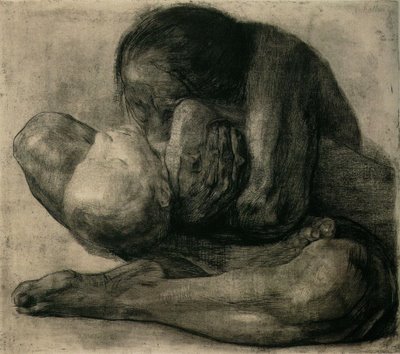
Her images trigger emotion in me, and more importantly, I believe the emotion that came from her. I believe her anger, her compassion, her pain, and her ability to understand that her experience did not belong to her alone, but was (and would sadly be)shared by so many mothers across time and space.
Kathe Schmidt was born on July 8th, 1867 in a city named Konigsberg in Prussia. She was raised by a strong and caring family. She studied painting at an early age, and was soon enamored with the expressive techniques of etching and printing. Ink drawing was her real passion. Linework and graphic black and white presentation gave voice to her style of realism. Having visited Paris and Venice and seen much of the current style of colorful Impressionism, Kathe's choice to remain so dark was a reflection of artist max Klinger's writings: "Some themes should be drawn rather than painted. Some themes would be ineffective and even inartistic if rendered by means of painting." He taught that the darker aspects of life were reflected better in graphics. She embraced this belief, and immersed herself in drawing.
In 1891 she married a young Doctor named Karl Kollwitz who happily set up a studio space for his bride and then set up his own office across the hall. It was this situation that gave Kathe intimate views of illness, poverty, malnourishment and especially the plight of poor children in her community. Politics and history began to play heavily on her mind, and her primary successes as an artist came from a series called The weavers. It was one of the first bodies of art created in which a struggle for a better life by working class people was depicted sympathetically. When displayed at the Great Berlin Art Exhibit in 1898, a distinguished jury awarded the Weaver's cycle with a gold medal. Kaiser Wilhelm II feared The Weavers'social content, and referred to Kathe's work as "gutter art." He personally blocked the award from being given. This Veto was only the beginning of the censorship and discussion that would ultimately surround her creations.
Success and opportunity in her career was matched by happiness in her life as a wife and mother of two sons until the onset of The Great War when her youngest son Peter was killed in 1914. He had become filled by pro-military rhetoric and volunteered to become a soldier. Kathe the mother never recovered but Kathe the artist was empowered by this personal tragedy. She became the voice of a cause that could not have been more passionate. Her previous cycles of strikes and etchings of peasant rebellions were ultimately mere rehearsals for her own stand against war, or more specifically; those who destroy youth in order to employ them as soldiers. One of her favorite axioms was "Seed for the planting must not be ground up." The seed she spoke of represented the promising generations of children who are sytematically erased by the ever seductive war machine.
Her work became unflinchingly social as she created art to rally viewers against hunger, political corruption, abuse, and apathy. With her bold graphic style, she pleaded for compassion and action. "Peace" after the end of the war meant only humiliation and despair for the powerless citizens of the defeated Germany, and the treaty of Versailles left the Nation unable to fully reform. It took the evil Adolph Hitler to fan the embers of bitterness and despair into high reaching flames of ravenous Nationalism.
Hitler was a frustrated artist himself, who had received poor response from his architectural drawings as a student in Vienna. Along with his frightening plans to create a new Germanic empire, he believed that German art had been corrupted by contemporary ideas and anti-military social messages. When he obtained full power, newly blacklisted artists across the country were pressured to stop painting and Forbidden to exhibit. Kollwitz herself was forced to resign her position as an art instructor, and her works were removed from public museums. She was "courted" by the Third reich, who wished to have her return to the fold and retain her place of honor as one of Germany's greatest artists, if only she would renounce her previous work and produced art along party lines. While thousands of other citizens in all walks of life submitted to this kind of fascism and desperately sold out, Kollwitz would not.
Her work became illegal. Her shows were shut down. On one occasion she was threatened with being sent to a concentration camp for not cooperating with the Nazi police. When the newly constructed "House of German Art" exhibited eight hundred examples of art that Hitler approved of, she was not invited. Nor was she included in Hitler's infamous Degenerate Art Exhibition, where examples of art deemed unclean and unfit for viewing were mockingly put on display in a kind of "house of horrors" freak show. Worse perhaps than being ridiculed, Kathe was ignored by the State.
She remained in Berlin as many of her artist peers were purged from society. most fled or were imprisoned. She worked in private, and sent her drawings to New York, where she developed an enthusiastic following. With the outbreak of World War Two however, her ties to the U.S. were severed.
As Nazi propaganda boomed that Germany was winning the war, soon the truth was obvious. Allied planes launched unflinching retaliatory attacks against German civilian centers. Her own home was bombed during the intense air raids by allied planes, and her Grandson was among the dead as the country fell. She died on April 22nd 1945, just a few days before the total surrender of the Nazis, not knowing peace or the outcome of the War. Her final great artwork was the monument to all parents of dead soldiers. The Mourning Parents depicts two kneeling figures gripped in physical and internal torment. Different from the typical Christian pieta, there is no body to mourn. Instead, there is only a void...An empty space. It is a self-portrait of the artist and her faithful husband created for a cemetery in Belgium. A replica now stands in the preserved ruins of the Saint Alban church, beside the Rhine river in Cologne.
Cologne is also the home of the intimate and comprehensive Kathe Kollwitz Museum. Located above the bustling Neumarkt, visitors take an elevator to arrive at a world-class sanctuary of her art. The Cologne museum was specially built to retain the mood and scope of this amazing woman's commitment to the preservation of life. For all of the darkness and visions of death that emerge from her graphic work, it is her strength that is victorious. Unlike many glum symbolist, surrealist and expressive artists after her, Kollwitz created art which is firmly planted in the knowledge that humanity can live in a civilized realm of dignity and love. It is this love that keeps her images from becoming merely horrific. It is the dignity that helps her work transcend the mere political. To think of her work as being linked to a long-gone European crisis is a great mistake. Sadly, infact, her work appears to be timeless.
Our own time is ripe for the message of her universal artwork. The fervor of a handfull of men (always men...) is once again fanning flames into wars that defy reason. Every day, one can watch the news and observe children torn apart by car-bombs in the name of retribution, or air strikes in the name of liberation.
It is the numbingly cliched constant story of our advanced epoch. I am keenly aware of the cycles of history, and wonder how many Americans could hold to their heartfelt beliefs as firmly as old Kathe did if ever faced with the choice. Perhaps many of us. Perhaps a few. How would we respond to Fascism?
In any case, how governments treat their artists seems to be the canary in the coalmine of civilization. When the arts are free, people are free. When arts funding is up, culture flows. When art expression is valued, fear disappears. When these fruitful rules are not in play, the opposite will be true.
Kathe devoted her life to creating a kind of warning mechanism. Her images seem to be taken from out of today's world news instead of belonging to faded chapters from yesterday. We should allow ourselves to question the direction that a half-a-dozen or so world rulers are steering the Earth. Without a doubt, If we follow the old course, we will come to view her art as simply proof that "others had tread this way before".
Others before us lost their babies.
Others before us stood in long bread lines.
Previous neighborhoods have been obliterated.
Similar anthems were once shouted.
Kathe hoped for a change in this cycle. As she died in the last days of the second world war, she could have only hoped that the people and cultures of the Earth would somehow survive. She probably wished that her art would speak to others in a future century, to remind them that we all share the same salt in our tears, the same habits of heart and the same ability to have courage when we are led astray from the path of wisdom and peace.
Experience her work. Treat it as a gift. She created it for us.
These words were written by a mother whose son was taken from her during a ravaging war. This fact alone did not differ her mourning and grief from that of hundreds of thousands of other mothers across the cycles of human history. She was also an educated, articulate teacher holding prestigious honors. This could have been said of thousands of people, but rarely about a woman living in a male dominated Germany in 1922. All of These honors were to be suddenly stripped from her, (or deliberately shedded by her), as the fascist machine called Nazism gutted Berlin along with all Deutschland of it's cultural decency.
This particular woman was an artist, and this made all the difference in her journey. It ensured that she would not be barren after her losses. It ensured that her existence would not be erased by the cruel boots of evil. This one aspect above all ensured that there now exists a record of her pain, her strength and her amazing life...
The woman's name was Kathe Kollwitz.
She was an artist who would not crumble. She would not sell her very soul to the devil or embrace a false ideal in exchange for promises of safety. For this, Kathe (pronounced KAY-teh) is a champion hero and a model that all humans should hold in their heart. She is the embodiment of art and courage. Kathe's art is like a time-released message to us, sent from a past century to our own.
When I first saw a work of art by Kollwitz, it was a defining moment for me. I was eighteen, in art school, and had bought a book on "expressive drawing". My first exposure to Kollwitz was her lithograph, A Woman with dead child. It resonates with the greatest strength and the most authentic sensitivity I can imagine. The design appears as if a rock has been tossed into a pond, and the ripples radiate outward from the center. While kathe was a master of human anatomy, she does not waste our time, or her own, by rendering every body part simply for show. She selects the most vital elements. It is anatomy in action and anatomy with meaning. She gives us unflinching clarity and soft mystery, while she conjures horror and intimacy. Line merges with stain and death marries life. She created the image by looking at herself, posing in front of a mirror with her own eight year old son, Peter. It was to become a prophetic image, as years later, her son would be killed in the first days of World War One.
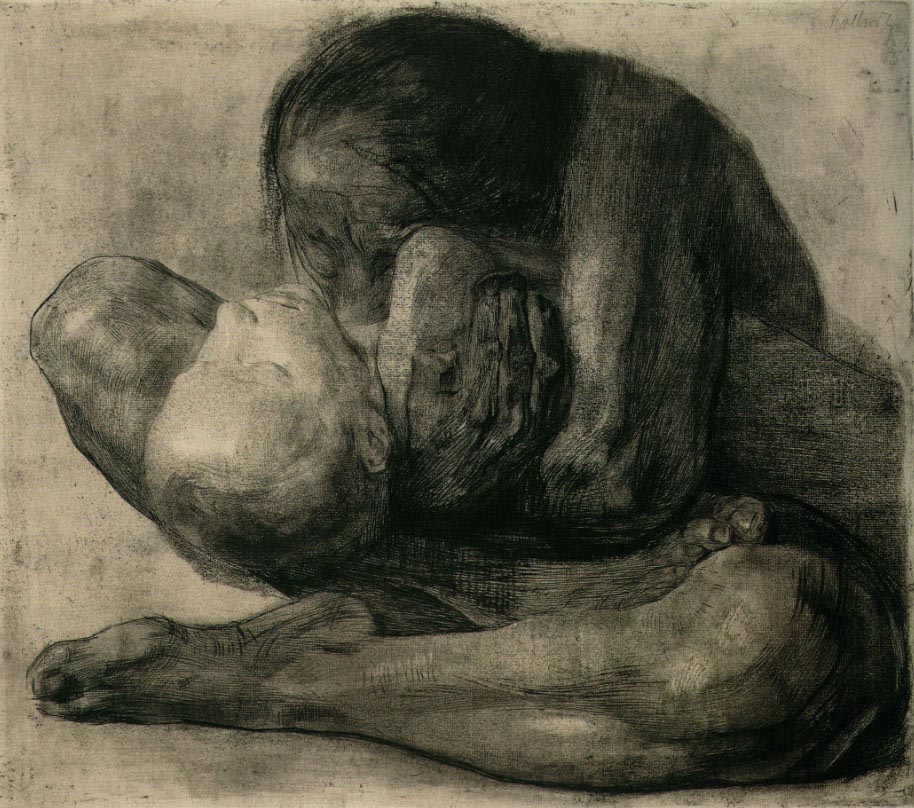
Her images trigger emotion in me, and more importantly, I believe the emotion that came from her. I believe her anger, her compassion, her pain, and her ability to understand that her experience did not belong to her alone, but was (and would sadly be)shared by so many mothers across time and space.
Kathe Schmidt was born on July 8th, 1867 in a city named Konigsberg in Prussia. She was raised by a strong and caring family. She studied painting at an early age, and was soon enamored with the expressive techniques of etching and printing. Ink drawing was her real passion. Linework and graphic black and white presentation gave voice to her style of realism. Having visited Paris and Venice and seen much of the current style of colorful Impressionism, Kathe's choice to remain so dark was a reflection of artist max Klinger's writings: "Some themes should be drawn rather than painted. Some themes would be ineffective and even inartistic if rendered by means of painting." He taught that the darker aspects of life were reflected better in graphics. She embraced this belief, and immersed herself in drawing.
In 1891 she married a young Doctor named Karl Kollwitz who happily set up a studio space for his bride and then set up his own office across the hall. It was this situation that gave Kathe intimate views of illness, poverty, malnourishment and especially the plight of poor children in her community. Politics and history began to play heavily on her mind, and her primary successes as an artist came from a series called The weavers. It was one of the first bodies of art created in which a struggle for a better life by working class people was depicted sympathetically. When displayed at the Great Berlin Art Exhibit in 1898, a distinguished jury awarded the Weaver's cycle with a gold medal. Kaiser Wilhelm II feared The Weavers'social content, and referred to Kathe's work as "gutter art." He personally blocked the award from being given. This Veto was only the beginning of the censorship and discussion that would ultimately surround her creations.
Success and opportunity in her career was matched by happiness in her life as a wife and mother of two sons until the onset of The Great War when her youngest son Peter was killed in 1914. He had become filled by pro-military rhetoric and volunteered to become a soldier. Kathe the mother never recovered but Kathe the artist was empowered by this personal tragedy. She became the voice of a cause that could not have been more passionate. Her previous cycles of strikes and etchings of peasant rebellions were ultimately mere rehearsals for her own stand against war, or more specifically; those who destroy youth in order to employ them as soldiers. One of her favorite axioms was "Seed for the planting must not be ground up." The seed she spoke of represented the promising generations of children who are sytematically erased by the ever seductive war machine.
Her work became unflinchingly social as she created art to rally viewers against hunger, political corruption, abuse, and apathy. With her bold graphic style, she pleaded for compassion and action. "Peace" after the end of the war meant only humiliation and despair for the powerless citizens of the defeated Germany, and the treaty of Versailles left the Nation unable to fully reform. It took the evil Adolph Hitler to fan the embers of bitterness and despair into high reaching flames of ravenous Nationalism.
Hitler was a frustrated artist himself, who had received poor response from his architectural drawings as a student in Vienna. Along with his frightening plans to create a new Germanic empire, he believed that German art had been corrupted by contemporary ideas and anti-military social messages. When he obtained full power, newly blacklisted artists across the country were pressured to stop painting and Forbidden to exhibit. Kollwitz herself was forced to resign her position as an art instructor, and her works were removed from public museums. She was "courted" by the Third reich, who wished to have her return to the fold and retain her place of honor as one of Germany's greatest artists, if only she would renounce her previous work and produced art along party lines. While thousands of other citizens in all walks of life submitted to this kind of fascism and desperately sold out, Kollwitz would not.
Her work became illegal. Her shows were shut down. On one occasion she was threatened with being sent to a concentration camp for not cooperating with the Nazi police. When the newly constructed "House of German Art" exhibited eight hundred examples of art that Hitler approved of, she was not invited. Nor was she included in Hitler's infamous Degenerate Art Exhibition, where examples of art deemed unclean and unfit for viewing were mockingly put on display in a kind of "house of horrors" freak show. Worse perhaps than being ridiculed, Kathe was ignored by the State.
She remained in Berlin as many of her artist peers were purged from society. most fled or were imprisoned. She worked in private, and sent her drawings to New York, where she developed an enthusiastic following. With the outbreak of World War Two however, her ties to the U.S. were severed.
As Nazi propaganda boomed that Germany was winning the war, soon the truth was obvious. Allied planes launched unflinching retaliatory attacks against German civilian centers. Her own home was bombed during the intense air raids by allied planes, and her Grandson was among the dead as the country fell. She died on April 22nd 1945, just a few days before the total surrender of the Nazis, not knowing peace or the outcome of the War. Her final great artwork was the monument to all parents of dead soldiers. The Mourning Parents depicts two kneeling figures gripped in physical and internal torment. Different from the typical Christian pieta, there is no body to mourn. Instead, there is only a void...An empty space. It is a self-portrait of the artist and her faithful husband created for a cemetery in Belgium. A replica now stands in the preserved ruins of the Saint Alban church, beside the Rhine river in Cologne.
Cologne is also the home of the intimate and comprehensive Kathe Kollwitz Museum. Located above the bustling Neumarkt, visitors take an elevator to arrive at a world-class sanctuary of her art. The Cologne museum was specially built to retain the mood and scope of this amazing woman's commitment to the preservation of life. For all of the darkness and visions of death that emerge from her graphic work, it is her strength that is victorious. Unlike many glum symbolist, surrealist and expressive artists after her, Kollwitz created art which is firmly planted in the knowledge that humanity can live in a civilized realm of dignity and love. It is this love that keeps her images from becoming merely horrific. It is the dignity that helps her work transcend the mere political. To think of her work as being linked to a long-gone European crisis is a great mistake. Sadly, infact, her work appears to be timeless.
Our own time is ripe for the message of her universal artwork. The fervor of a handfull of men (always men...) is once again fanning flames into wars that defy reason. Every day, one can watch the news and observe children torn apart by car-bombs in the name of retribution, or air strikes in the name of liberation.
It is the numbingly cliched constant story of our advanced epoch. I am keenly aware of the cycles of history, and wonder how many Americans could hold to their heartfelt beliefs as firmly as old Kathe did if ever faced with the choice. Perhaps many of us. Perhaps a few. How would we respond to Fascism?
In any case, how governments treat their artists seems to be the canary in the coalmine of civilization. When the arts are free, people are free. When arts funding is up, culture flows. When art expression is valued, fear disappears. When these fruitful rules are not in play, the opposite will be true.
Kathe devoted her life to creating a kind of warning mechanism. Her images seem to be taken from out of today's world news instead of belonging to faded chapters from yesterday. We should allow ourselves to question the direction that a half-a-dozen or so world rulers are steering the Earth. Without a doubt, If we follow the old course, we will come to view her art as simply proof that "others had tread this way before".
Others before us lost their babies.
Others before us stood in long bread lines.
Previous neighborhoods have been obliterated.
Similar anthems were once shouted.
Kathe hoped for a change in this cycle. As she died in the last days of the second world war, she could have only hoped that the people and cultures of the Earth would somehow survive. She probably wished that her art would speak to others in a future century, to remind them that we all share the same salt in our tears, the same habits of heart and the same ability to have courage when we are led astray from the path of wisdom and peace.
Experience her work. Treat it as a gift. She created it for us.
Saturday, June 24, 2006
The Smooth Art Of The Bush Years

When Napoleon Bonaparte conquered France, he was not ignorant about the power of art to reflect his regime's ideals. He was also quite aware of art's ability to affect public opinion. He wisely chose Jacques-Louis David to head up the French Art world and gave him reign over the content, style and moral role that painting would play in the growingly oppressive Napoleonic empire. Jacques-Louis David was a great painter, and he devised a technique of working that would best serve the propaganda machine and methodology of the self-crowned Emperor.
Bonaparte realized that individual voices of dissent could grow and threaten his rule. It would become vital to neutralize these voices. David was employed to develop an approach to art-education and philosophy that would do just that. His most obvious tool was to eliminate the individual voice which comes from brushstrokes in a painting. When French artists created an artwork, therefore; it was imperative that they "erase" their individual voice. The school of David preached that smooth, flat surfaces were what all painters should strive to achieve and emulate. The school of David produced some gorgeously cool masterpieces which occupy a unique place in art history and the technical strength and allegorical impact of Napoleonic painting is beyond question. The works of these Napoleonic painters appear as polished, smooth, hard-edged and nearly photographic in their overall distribution of detail.
Folks, it took three generations of painters to free art from the strict cannons of smooth Napoleonic neo-classiscism. A fourth and fifth generation fought and died to bring the personal and expressive brushstroke to it's full articulation, purity and ultimately abstract power. Today, painting is seeing a resurgence. Realism, Impressionism, decorative applications, expressive solutions, International appropriation and even pop-culture cartoon stylistics are all choices available to the creative artist at the beginning of our twenty-first century. They are all valid, they are all widely practiced, and even marketable. How far we have come from the days when a single finger of art drove the entire body!
When The National portrait Gallery in Washinton D.C. announced last year that they would be hosting the Outwin Boochever Portrait Competition in 2006, artists of all backgrounds across America joyously submitted a portrait that reflected their relationship with their sitter. The event would be amazing. Perhaps it would be a survey of the multi-lingual artscape that our country has finally become. A return to portraiture as a revered contemporary subject could spell walls and walls of paintings dripping with expressive humanity. The task of creation and rush to submit to the event was embarked upon by well-over four thousand artists. The competition would be great, as only fifty or so paintings would be chosen by a distinguished jury for exhibition in time to coincide with the National Portrait Gallery's grand reopening on July 4th.
Now that the paintings have been chosen and the winner of the twenty-five thousand dollar first prize has been announced, it is of historical and artistic interest to see what has in effect, become the official art of the George W. Bush era.

When I clicked on the website of the National Portrait Gallery to
view the paintings shortlisted for the grand prize, I was met with a group of beautiful paintings that all had specific things in common: They appeared to be polished, smooth, hard-edged and nearly photographic in their overall distribution of detail...
"Sacre Bleu!" Shouts the ghost of the long-dead Napoleon Bonaparte. "Vive Le Emperor!"
A recent article in The Washington Post discussed the exhibition in terms of it's obsessive embrace of a single harsh painting style. Painting comes in many forms, and it seems odd that such a severe photo-dependent product be so highly showcased to the exclusion of so many other choices and possibilities. I know of a hundred or so portrait artists whose work was not chosen for the exhibition. Many of them were working in various expressive or "painterly" styles of realism. Most of them employed unblended brushstrokes in their creative process.
Let's face it, judging art is a lot like judging a bar-b-que ribs cook-off. One judge might like hickory smoke flavoring, while another goes for sweet Missouri style sauce. Some like meat falling off the bone, while other judges might go for firmer mouthfulls. In the end, personal taste must prevail, and be respected. It is still remarkable to me that such a large jury panel was so enamored with this Napoleonic aesthetic, when so many styles were submitted. What does this say about the image of the American human in our time? What does this say about the expectations Washington D.C. Curators have about contemporary painters?
It is also interesting to note that across the pond, The London National Portrait Gallery has opened their annual Open exhibition, which also features a select group of paintings based upon the same Napoleonic severity. Additionally, the lack of color in the London exhibition is interesting. Historically color use in art is equated with periods of freedom, vibrancy, passion and liveliness of a culture. What does this lack of color say about our times? Or the artist's perception of their role?
Certainly, to have such prestigious portrait exhibitions is a triumph in the wake of the modernist jihad that tried to erase the language of realism from the face of the earth in the last century. These are exciting events for lovers of art and creators of painting. Still, I like to ask the larger questions at hand.
Do we realist-artists ever question our own philosophies? Were we born to simply "paint as real as we can" ? Are our individual voices -our brushstrokes- distractions to be smoothed over? In the future, historians will look back to our time and perhaps see an amusing parallel to another epoch. They will marvel at the way cycles of politics echo cycles of art. They will note who marched in step with these cycles...and they will note who embraced the brushstroke. Let's beat these historians to the punch. Let's ask these questions now.
Tuesday, June 20, 2006
Smile America! You Love Art!
"Nobody cares about art. No one really cares."
My friend Peter spoke these words aloud, and they hung there in the air with the weight of a comfortable reclining chair. He stared out his studio window, waiting for me to repeat his mantra. Before I could speak, he churned out another sorrowful statement, punctuated with a heavy sigh. "It just seems that nobody is interested in art anymore."
Of course, only an artist would ever say these words. In times of despair, they have come from my lips as well. But no longer. Why? Because they are so far from truth that it is almost hysterical. Maybe smack in the middle of the last decade a comment like that would have garnered a conquering chorus of grumbling hallelujahs, but not in today's America. Today's American citizen is absolutely in love with art.
With this in mind I broke the disparaging mood in the room by asking my defeated artist friend, "What was the number one movie in the land last week, and the number one best-selling book last year? I'll tell you: the frickin' Da Vinci Code. The story takes place in the Louvre Museum and is all about looking at art. And did you hear? Yesterday the highest amount ever paid for a painting was set in auction: 135 million dollars for a Gustav Klimt painting, beating out Picasso's chincey 106 million dollar price from two years ago! The Klimt is going to the Neues Museum in Manhattan, where hundreds of thousands of people will make their way to see it! And believe me, admission ain't gonna be free! They will all gladly shell out big bucks to get in, and then they will slap down the plastic at the souvenir counter to buy Klimt posters, Klimt refridgerator magnets, and Klimt oven mits"
My painter friend just stared.
"And another thing," I resumed, climbing up to stand on a table, "The number one shows on television today are about people... real people...involved in the art of singing and ballroom dancing! America loves this art thing! America is done with car-chase shows and folks eating tarantula intestines and caterpillar smoothies on a dare. They actually want to see somebody get better at their craft, even if it means risking getting humiliated. They want to see somebody just like them take a stand and become a singing star or a tango hero! Whatd'ya mean nobody cares about art!?"
I stood panting with sweat beads dripping from my forehead. My chest heaved passionately as I awaited a response.
"Mere circuses and cakes," Peter retorted, dismissing me with a wave of his paint-covered hand. "You call junk-culture art? You call inflated commerce an indication of our nation's taste? Our nation has taste all right, but it's in its mouth, and that's about it."
"Ah jeez!" I countered. "Step down from the ivory tower, your majesty. This junk-culture as you call it serves as a kind of, you know, gateway-drug. It's like an appetizer before you can swallow the main course. It's like stretching before you run a marathon. The world has to develop a taste for art before they are ready to feast on it."
Peter ignored me. " What about our government? Why is the American government willing to spend billions on the military to fight our current economic-religious war in the middle East while diminishing all arts funding at home? Our schools rarely embrace the arts, and less and less government funds are put towards this universal language of peace and expression. I mean my God, even someone as wicked as Hitler supported the arts. During World War Two even he considered the arts vital. If the "ultimate evil guy" supported the arts, why can't our "good guys" in Washington do the same, but with grace and wisdom?"
"Now you've done it!" I taunted. "Whenever people bring up Hitler in an argument, you know that they are becoming cranky. Good Lord, are you saying that Hitler was a moral keeper of culture? Please be open to good news! Just tone down your pessimism and release your demands that the whole garden bloom at once." I grew sage-like as my heart glowed with hope. I continued with my hand gently and firmly on his shoulder. "Allow a few flowers to blossom before the others. Allow a beginning to take shape. Think of it as a start. Our culture is letting art into daily life like never before. Be positive. Be open to the possibilities. people do care."
My friend looked quietly down at the floor. After a few moments he spoke. "I guess you may be right. Maybe people are thinking about art more. Maybe they will develop a real thirst for it. Maybe this is the beginning, when our culture begins to grow. Maybe art will join every aspect of life, enriching it and leading to a future of harmony, poetry and beauty."
He paused. "I...still don't have to consider McDonald's new breakfast croissandwich as Haute cuisine though, do I?"
I smiled. We hugged.
My friend Peter spoke these words aloud, and they hung there in the air with the weight of a comfortable reclining chair. He stared out his studio window, waiting for me to repeat his mantra. Before I could speak, he churned out another sorrowful statement, punctuated with a heavy sigh. "It just seems that nobody is interested in art anymore."
Of course, only an artist would ever say these words. In times of despair, they have come from my lips as well. But no longer. Why? Because they are so far from truth that it is almost hysterical. Maybe smack in the middle of the last decade a comment like that would have garnered a conquering chorus of grumbling hallelujahs, but not in today's America. Today's American citizen is absolutely in love with art.
With this in mind I broke the disparaging mood in the room by asking my defeated artist friend, "What was the number one movie in the land last week, and the number one best-selling book last year? I'll tell you: the frickin' Da Vinci Code. The story takes place in the Louvre Museum and is all about looking at art. And did you hear? Yesterday the highest amount ever paid for a painting was set in auction: 135 million dollars for a Gustav Klimt painting, beating out Picasso's chincey 106 million dollar price from two years ago! The Klimt is going to the Neues Museum in Manhattan, where hundreds of thousands of people will make their way to see it! And believe me, admission ain't gonna be free! They will all gladly shell out big bucks to get in, and then they will slap down the plastic at the souvenir counter to buy Klimt posters, Klimt refridgerator magnets, and Klimt oven mits"
My painter friend just stared.
"And another thing," I resumed, climbing up to stand on a table, "The number one shows on television today are about people... real people...involved in the art of singing and ballroom dancing! America loves this art thing! America is done with car-chase shows and folks eating tarantula intestines and caterpillar smoothies on a dare. They actually want to see somebody get better at their craft, even if it means risking getting humiliated. They want to see somebody just like them take a stand and become a singing star or a tango hero! Whatd'ya mean nobody cares about art!?"
I stood panting with sweat beads dripping from my forehead. My chest heaved passionately as I awaited a response.
"Mere circuses and cakes," Peter retorted, dismissing me with a wave of his paint-covered hand. "You call junk-culture art? You call inflated commerce an indication of our nation's taste? Our nation has taste all right, but it's in its mouth, and that's about it."
"Ah jeez!" I countered. "Step down from the ivory tower, your majesty. This junk-culture as you call it serves as a kind of, you know, gateway-drug. It's like an appetizer before you can swallow the main course. It's like stretching before you run a marathon. The world has to develop a taste for art before they are ready to feast on it."
Peter ignored me. " What about our government? Why is the American government willing to spend billions on the military to fight our current economic-religious war in the middle East while diminishing all arts funding at home? Our schools rarely embrace the arts, and less and less government funds are put towards this universal language of peace and expression. I mean my God, even someone as wicked as Hitler supported the arts. During World War Two even he considered the arts vital. If the "ultimate evil guy" supported the arts, why can't our "good guys" in Washington do the same, but with grace and wisdom?"
"Now you've done it!" I taunted. "Whenever people bring up Hitler in an argument, you know that they are becoming cranky. Good Lord, are you saying that Hitler was a moral keeper of culture? Please be open to good news! Just tone down your pessimism and release your demands that the whole garden bloom at once." I grew sage-like as my heart glowed with hope. I continued with my hand gently and firmly on his shoulder. "Allow a few flowers to blossom before the others. Allow a beginning to take shape. Think of it as a start. Our culture is letting art into daily life like never before. Be positive. Be open to the possibilities. people do care."
My friend looked quietly down at the floor. After a few moments he spoke. "I guess you may be right. Maybe people are thinking about art more. Maybe they will develop a real thirst for it. Maybe this is the beginning, when our culture begins to grow. Maybe art will join every aspect of life, enriching it and leading to a future of harmony, poetry and beauty."
He paused. "I...still don't have to consider McDonald's new breakfast croissandwich as Haute cuisine though, do I?"
I smiled. We hugged.
Subscribe to:
Posts (Atom)