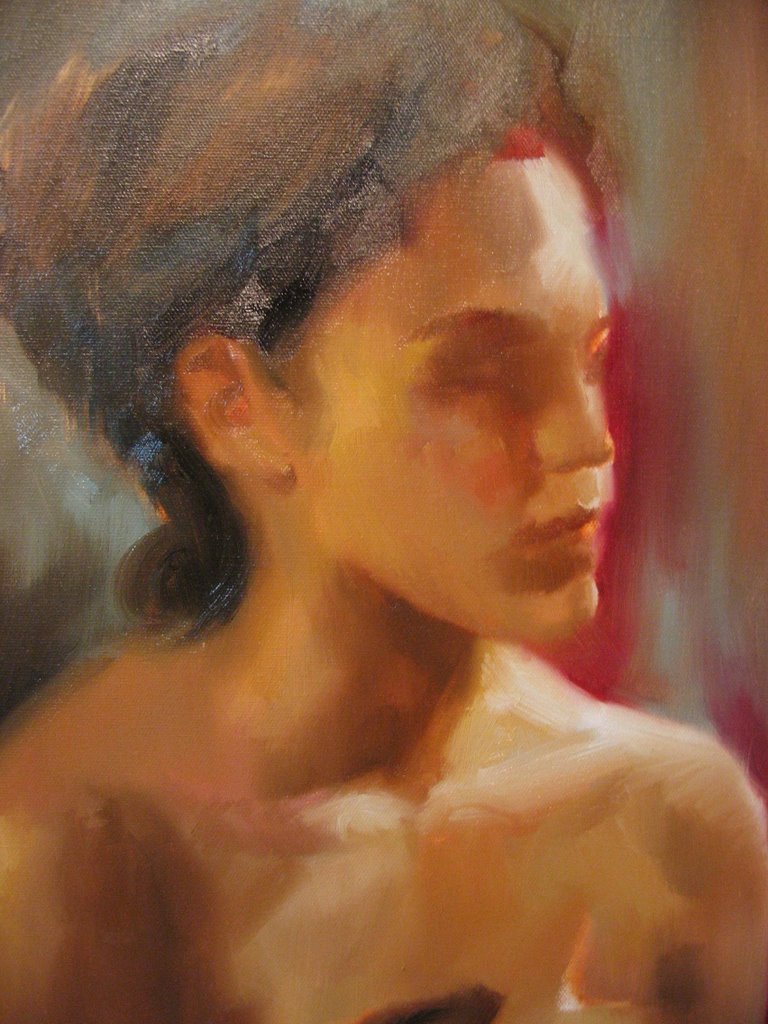
Saturday, January 27, 2007

Wabi-Sabi: Imperfect Beauty


[Tokyo Rain by John Paul Thornton]


"What is Wabi-Sabi?" I asked.

It was a rain-drenched evening in Tokyo. A typhoon had hit earlier that day, spawning seas of bustling umbrellas beneath the towering neon skyscrapers of the Blade-Runner like Shinjuku district. In the midst of the flury I had been driven by a pair of Japanese artists to the Tokyo Museum of Art. We could be dry, and become lost in the comforting quiet that museums extend to the weary.

“What does Wabi-Sabi mean?”
The question was innocent enough, but my Japanese hosts just responded with big smiles that grew into nervous laughs. I stood there in the middle of the Museum, waiting for them to answer me. Instead, they turned away as if the matter were closed and walked ahead to silently ponder a ceramic bowl.

Say “Wah-bee Saw-bee”

I had never heard of the word Wabi-Sabi until my hosts had begun whispering it to each other while they strolled through the art exhibits. What was Wabi-Sabi? I was intrigued by the sound of the word and the reverential expression that fell upon the faces of my new friends when it’s little song passed their lips. Boldly, I approached them again to translate this new word in English for me.

“Really guys, what does Wabi-Sabi mean?”
My third request was only met with more nervous laughter and awkward silence. We took a break for Sakai at the Museum café. After a few drinks and further discussion about Japanese art, I boldly asked them again about the meaning of the word I had heard them use. Finally one of my hosts, a famous Japanese artist, turned to me and with his brow furrowed in thought he spoke:
“There is no… precise translation for Wabi-Sabi” Then he said: “Imagine a landscape. It is night. The full moon hangs in the sky but a cloud passes before it, obscuring it. A jagged tree is silhouetted against the luminous sky. A breeze causes gentle movement in the branches. Far away a dog barks.” He fell silent and eyed my reaction, which was to sit dumbfounded before him.
He began again. “A wall of rock rises beside a well-worn trail. The rock is covered with moss and is marked with fissures and cracks from centuries of winters. A single delicate flower grows out from the rough surface.”

I realized that he was answering me in koans, a Zen Buddhist tradition of presenting a student with an unanswerable riddle.
Still, I did not fully comprehend. My new friend took pity on me. He shrugged and then cautiously gave me this answer: “Wabi-Sabi means…beautiful imperfection.”

Beautiful imperfection? I dared not pester them with more pleas for meaning, but I wanted to better understand. Equipped with this concept, we re-entered the museum and came to a room filled with four hundred year old cooking ware and painted screens. We passed by a row of perfectly formed tea cups with exquisitely decorated rims so that we could admire a single slightly misshapen cracked bowl, whose colors were varied and muddied. Instead of a smooth finish, it was uneven and subtly blemished. I continued to stare at this vessel for a while, unmoving and silent.
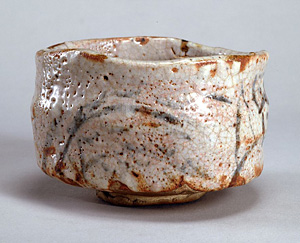


My brain was still reeling from the glamour of Tokyo. The neon colors and frantic activity of the city had to be pushed away. I focused on the stillness of the room as I relaxed my breathing. Finally my impatient mind and chatty mouth quieted. I became aware of the bowl and all of it’s features. It was delicate yet rough. Crooked yet functional. Ugly yet compelling. Imperfect and beautiful. Without words I was then escorted to a display case containing a faded wooden folding screen onto which was painted a flurry of brushstrokes representing a cherry tree in an open field. A hazy mountain pierced low-laying clouds in the background. As I paused, the active disunity of the brushstrokes merged to form a complete motif. I became aware of each stroke, and each decision made by the artist. I noticed the emptiness between each brushstroke and the silent mood that the image evoked in me. The worn surface of the wood hinted at...what? Nostalgia, reverence, dignity.

I felt calm and giddy. My heart raced as I experienced a kind of sensation we artists feel when a great ignorance is removed from our perception and we encounter truth. The rest of the day, everything was transformed to my eyes. The remainder of my stay in Japan was a finely tuned awareness which has continued on into my life ever since. Visual aspects of the world have become almost magically enhanced. This has led to something else: I became aware of my own painting in ways I never had before: I became aware of what I now call poetry.

Wabi-Sabi is really two words, each with a deep and nearly untranslatable mmeaning.

Wabi stems from the Japanese root wa, meaning “peaceful,” “harmonious” and “at ease.” In it’s original meaning, wabi had a slightly belittling connotation of loneliness or sadness- withered or bleak. Yet it has now come to describe a healthy sense of humbleness and balance.

Sabi translates as “the effects of time”. The effects suggested are natural and part of a greater process. Think of how Rust overcomes an abandoned car in a field, turning it picturesque. Visualize the way surfaces fade and crack… how wrinkles overtake the skin of a woman as she gracefully ages or how intricate weeds entangle a neglected garden.
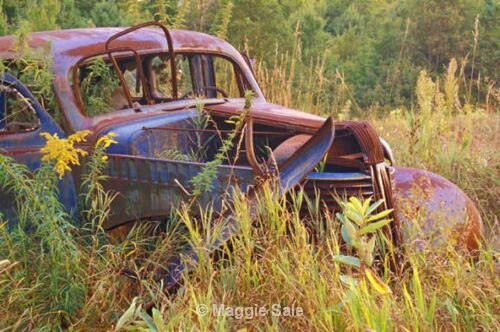


If Wabi means humble, and Sabi means weathered, then we have the exact opposite of the Western ideal of “perfection” nurtured by the Greeks and later by Europeans during the Renaissance.

America does not have a true phrase that is the equivalent of Wabi-Sabi. “Beautiful imperfection?” We have no such thing. We have adjectives like “antique,” “rustic,” and “weathered,” but these describe more of the imperfection of a thing rather than it’s beauty. We have phrases like “happy accident” or “controlled chaos,” but these fall short as well, sounding more like apologies rather than philosophies.

What I did rejoice in was the realization that this state, this feeling or whatever it was, was definable. Wabi-Sabi was something I had always loved and craved. It was the explanation for why the crumbled surfaces of paintings by Rembrandt radiate with such profound richness.
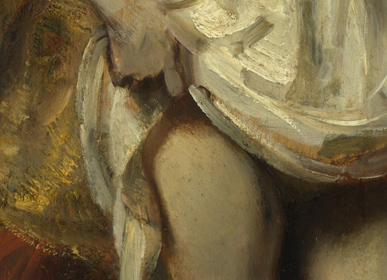

[Detail of Bathsheba by Rembrandt]
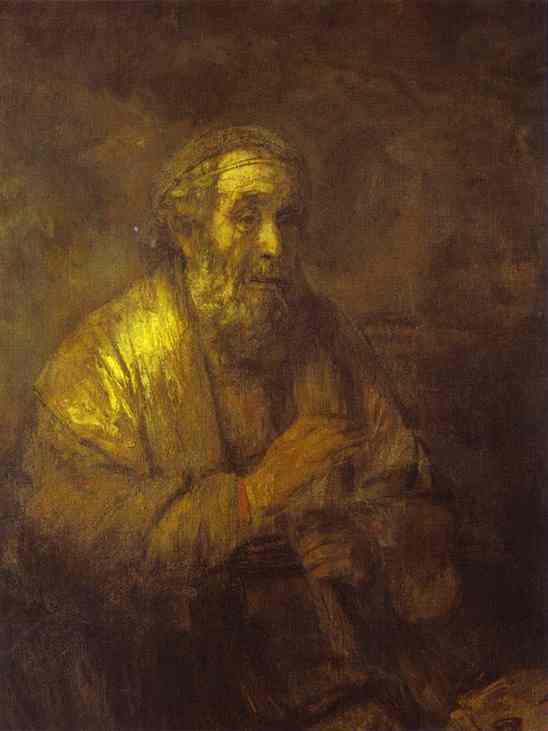

[Blind Philosopher by Rembrandt]

The European old masters allowed the paint variations to exist, unblended in their art. They applied paint with their fingers, or with their palette knives. They sought for a “feeling” rather than the visual replication of things.

Wabi-Sabi was the answer to the secret of Michelangelo’s unfinished marble figures called “the slaves” who appear to be still trapped in marble. They are half visible and half obscured, just like the moon had been described to me in my Japanese friend’s koan.


[The Slave by Michelangelo]


Wabi-Sabi was the hidden power behind the paintings and sculptures of the impressionists, whose glorious images of atmosphere and light seem to fall apart as the viewer steps closer to examine the surface of the canvas.


[Impressionist Sunrise by Claude Monet]

While much of the story of contemporary European and American painting has been a mad race to define “imperfection” as being pure ugliness, a similar effort has been made to define “beauty” as slick and neo-classical. What is missing is a striving for balance, a harmony of parts. Whether Western or Eastern, art is at it’s most dynamic and mature when it is drenched with “Wabi-Sabi”.

Of course,taking an ancient Japanese aesthetic and attempting to fit it into Western cultural experience may be looked upon as the height of ugliness. Then again, we are all linked to this sensation. While we all share an unspeakable longing for resolution, we withdrawl inward to remember and reflect. We all know the feeling of slipping our feet into worn, comfortable shoes.

Wabi-Sabi allows for personal expression, and individuality. There is a subtle quality that this implies- not the bombastic rush of adventure, but a quietness, or a transformation caught between phases. It is a lack of predictable precision. It is what we call A sense of mood.

Yet beyond art, we might go further in it’s broad implications. “Wabi-Sabi” could be a freeing way of approaching life. Embracing “Beautiful imperfection” would allow us to find poetry in the aspects of daily living which we now ignore or deplore.

Discover it in your world sometime unexpected, quietly.

Sunday, December 24, 2006

Pure Painting

There is no sense of good or bad. There is only activity, color and devotion.
It is an awe-inspiring thing to see forty six-year olds fill up forty blank papers with personal, meaningful creations...

I just finished conducting some holiday art workshops for children in Los Angeles. It is amazing to work alongside of little humans who create anything at a whim. They become so happy, and somtimes you can sense them nearly bursting with pride at what they have done.

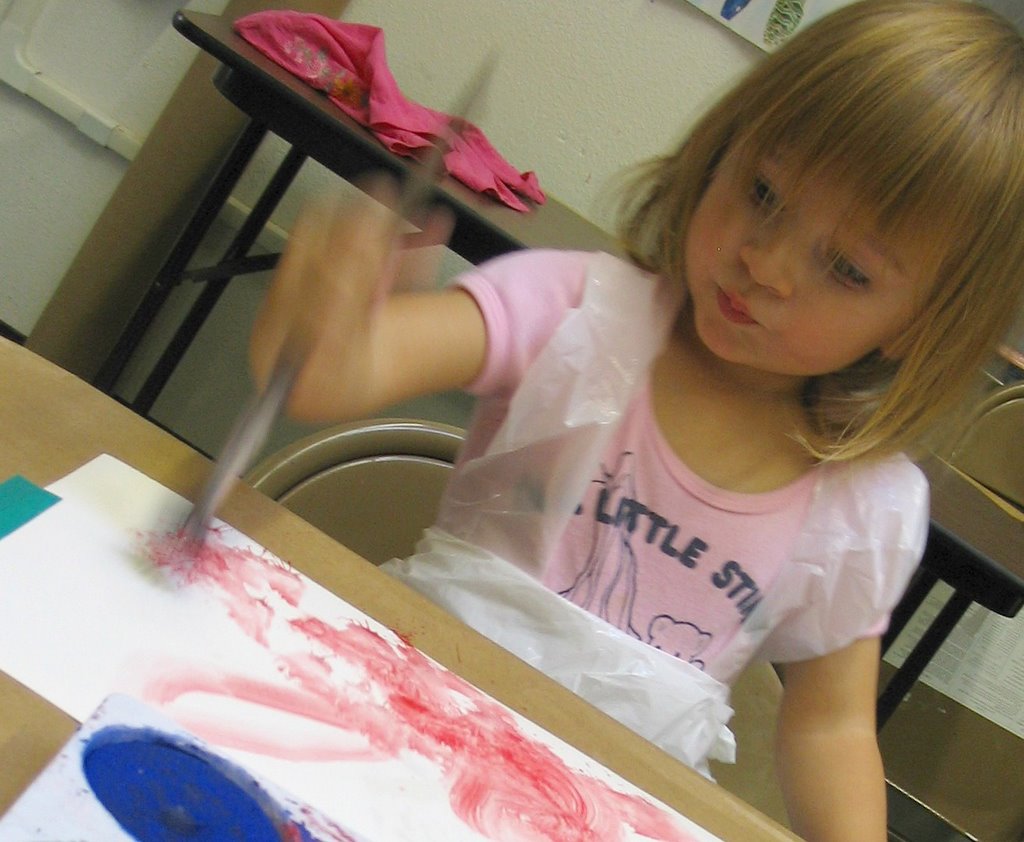
My own daughter Lorelei is two, and paints joyously. At times, she also gets very serious as she mixes the puddles of color...

Here is an image of her beginning a new painting on this Chrismas Eve.

Tuesday, December 12, 2006

From out of the Chaos


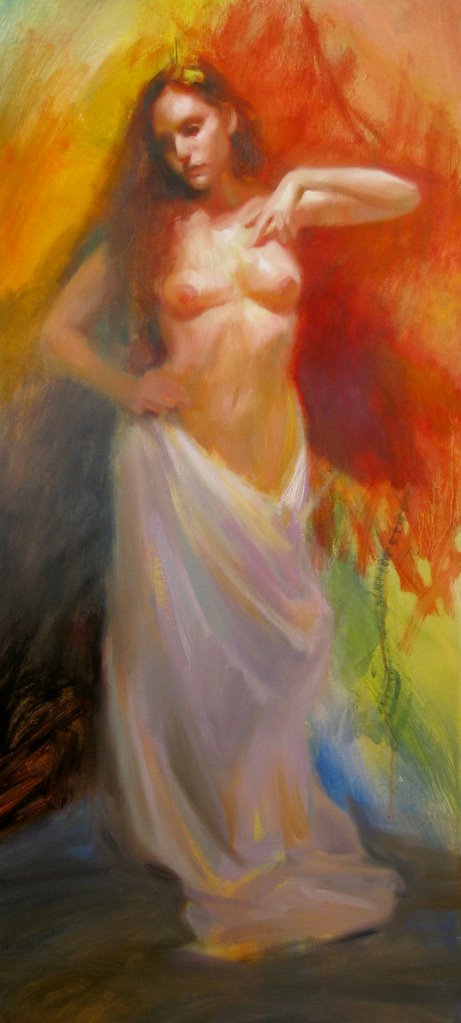
My favorite approach to figure painting is to leap into the process without hesitation. No preliminary drawings or daydreaming allowed! For this painting, the background was created beforehand by placing random marks and washes until a density of yellow hazy atmosphere is obtained. The canvas languished in my studio for nearly a year until the day I created this image. Somehow, the time was right, the surface was ready...like a wine that had come of age. I brought it to my model session with no doubt that it would be the chaos from which some kind of poetry would grow. The vertical thrust of the canvas suggested a standing pose, but the real inspiration was the dynamic pose of the model, who is a dancer.


Seeing how this painting appeared in it's earliest stage is exciting to me even now.


A few jagged lines suggest her movement without becoming too fixed or "perfect". I love working this way because it is accompanied by a real burst of energy, bravura and passion. As I squint to discern the visual pattern of light and shadow, I scrub in a luminous crimson wash to represent the darkness that seems to envelop her. The black wash on our left begins to define her light shape. At this stage, she resembles a spirit, an abstraction, but I do not stop here. My heart pounds. I always felt both liberated (and a bit guilty) when I began paintings this way. Shouldn't I be more concerned about clarity? Shouldn't my drawing skills be more controlled? Then I began finding X-rays of underpaintings by Titian and Velasquez where they began this way in the late Renaissance and Baroque periods. In an age of mathematical grids and royal patronage, they still let their brushes flow.


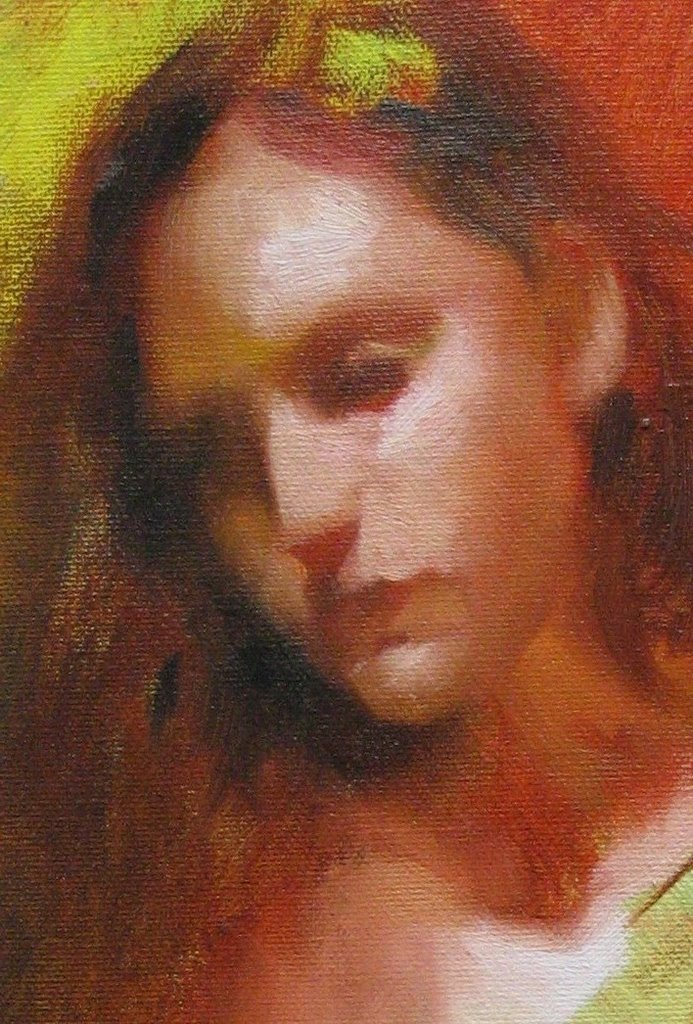
The next step is to focus. I begin with the face, which is built up with planes of structure which are gently softened together at their points of contact. Look how many edge variations I am employing. A few precious edges are left hard and sharp, but most dissolve and bleed into the areas surrounding them. I am careful to paint her features as they actually appear from across the room, not as detailed distractions. The overall quality of the skull, that is the bone structure, is most important here. The eye sockets appear deep and there is no defined eye, no actual glint of light. Just an indication of lid. The shadow under the nose falls across the lower face. The lips emerge from the forms of the muzzle, they are not pasted on the surface. The hairline comes and goes,allowing the strength of the nose and the light on the upper cheek to come forward. Less is more. Now I move down to the ribs and breasts.


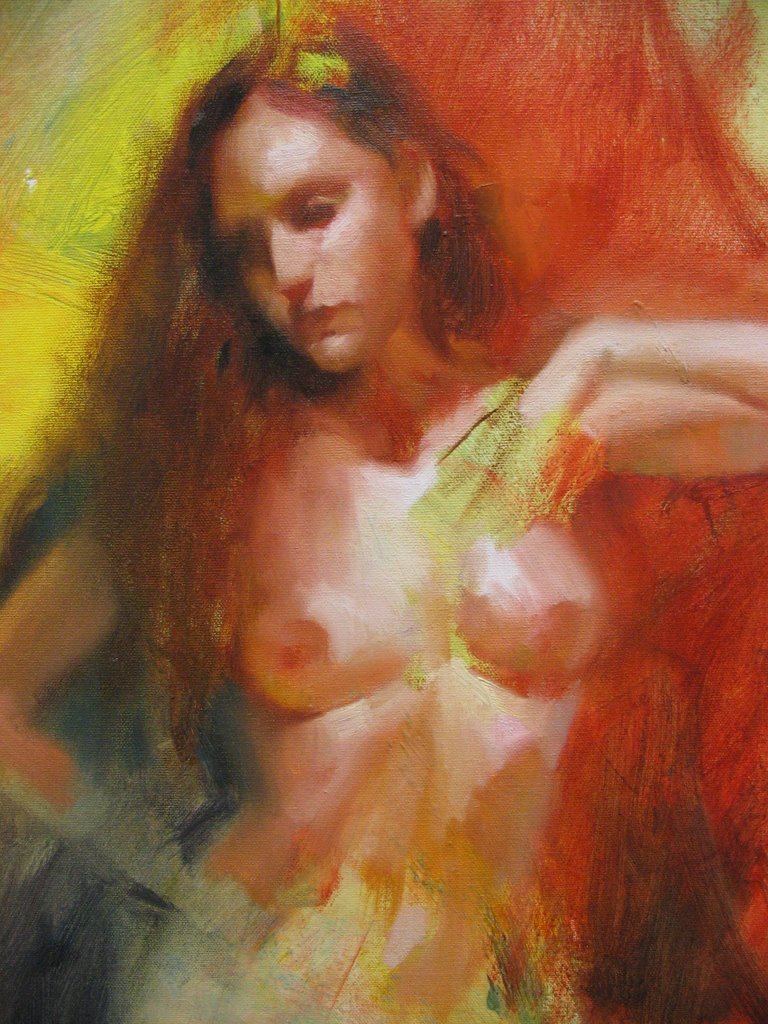
Paying attention to the light source, each individual plane of the breasts is stated with a descriptive stroke of paint. The form appears to receed as cool green grey is added. See how the general shadow on the flesh is a warm sienna. Areas where bone comes close to the surface appear cooler. Also, the form appears to receed as cool green grey is added. The "lights" of her flesh are a very cool bit of blue added to white. I blend very slowly, trying to maintain the clarity of each decision. You can almost count the brushstrokes.


On to the arms. Every stroke is actually a drawing decision. This way of painting is not "filling in the space between the lines". There are no lines! It feels more like sculpting. See how the random colors of the background peek through or are subdued as I go along. I love the hair...


Total figure painting time thus far: Three hours.


Creating her fallen gown demands that a suggestion of the covered legs beneath be indicated. Alternating slashes of warm and cool violet are arranged as simply as possible, with only a single slash of light at the top. Again, notice the yellow wash of the background, allowed to show through to provide a unity, as well as a compliment to the violet. The rest of the cloth falls into soft middle values and finally into a muted shadow. I add a blast of cobalt blue near the bottom to enhance the temperature shift. The gown and the process of refining the fusion with the airy space around the form takes an additional hour of painting. The hands become a three hour delicate game of hide and seek, alternating between structure and mere indication. The hint of knuckle, the thrust of the gesture are more tasteful than tiny details. I decide to leave the vague background as it began: a chaotic wash, from which she boldly emerges. Here is the finished painting:


[The Source by John Paul Thornton]

Thursday, November 23, 2006

Rattle


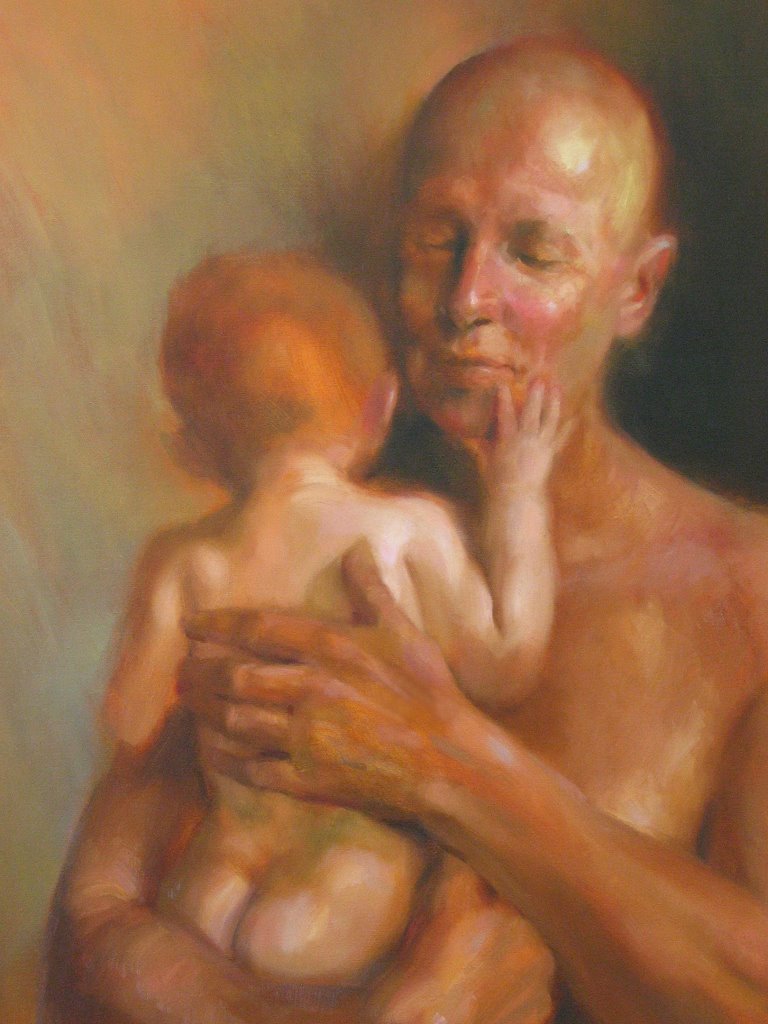
One of the most meaningful sights I have seen with my eyes, has been my father holding my daughter tenderly in his arms. My father is a gentle, complex man who has recently been battling cancer. My daughter is a radiant child full of affection and vigour.

While art history is packed with paintings depicting mothers and their children, the image of a man holding a small infant remains rare. To experience this interaction, to have it signify for me not only a vital part of my own life, but a rich reference to the life of any man who has held a delicate child, gives full power to the human figure as a symbol of spiritual signifigance and a subject without equal in my painting.

To attempt to conceptualize this image, or to abstract it into something that reflects less than it's direct impact upon my heart would be deceitful and self consciously apologetic.

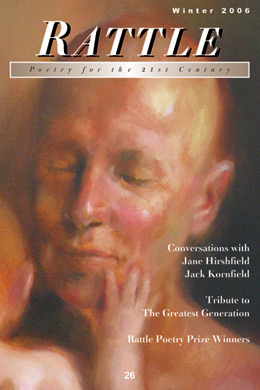
I am proud that my painting has been featured as the Fall 2006 cover of "Rattle- Poetry for the 21st Century" published by The Frieda C. Fox Family Foundation.


The image used is actually a detail of a full-sized portrait, which is shown in the book as well along with additional original paintings. I was very pleased to receive an advance copy of the book, and I must say that the printing is gorgeous and the poetry in the book's pages (written by poets from around the country) is thoughtful and intimate. I am very proud of the end results and grateful to all who thought of me as a contributing artist.

Information on how to order this book can be found by clicking on this link.


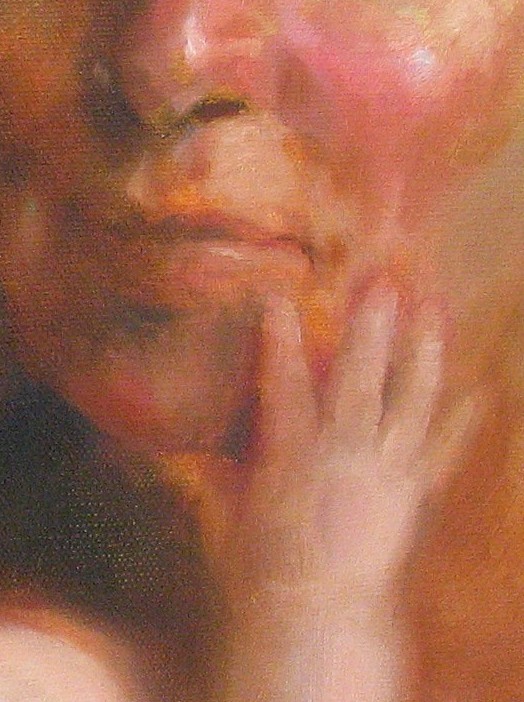
Here is the featured portion of the full painting called "Grandpa's Cure".

Wednesday, November 22, 2006

Flesh and Luminosity


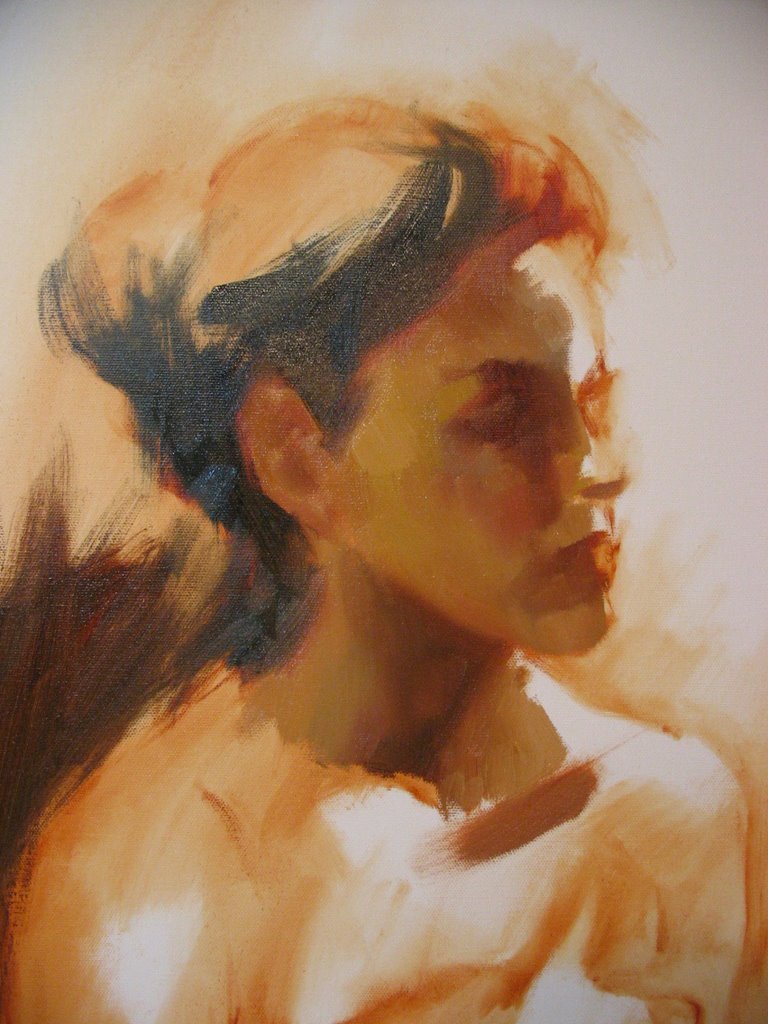
Earlier this year I did a portrait demonstration for an audience of about fifty people at the Fine Artists Factory in Pasadena, California.

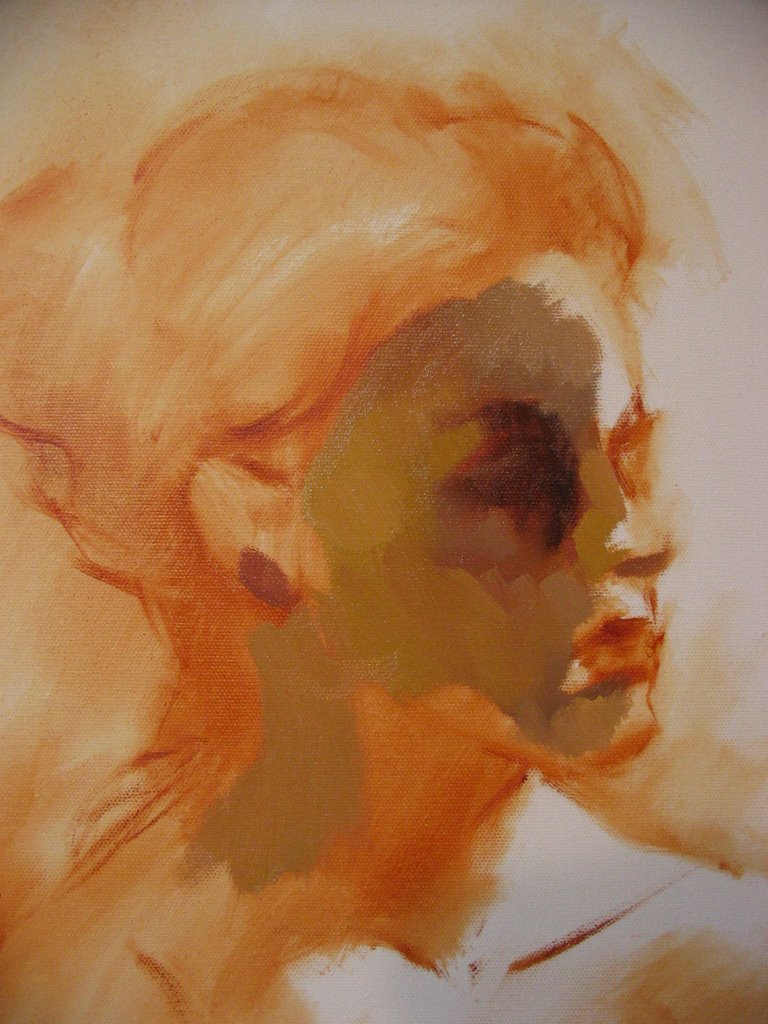
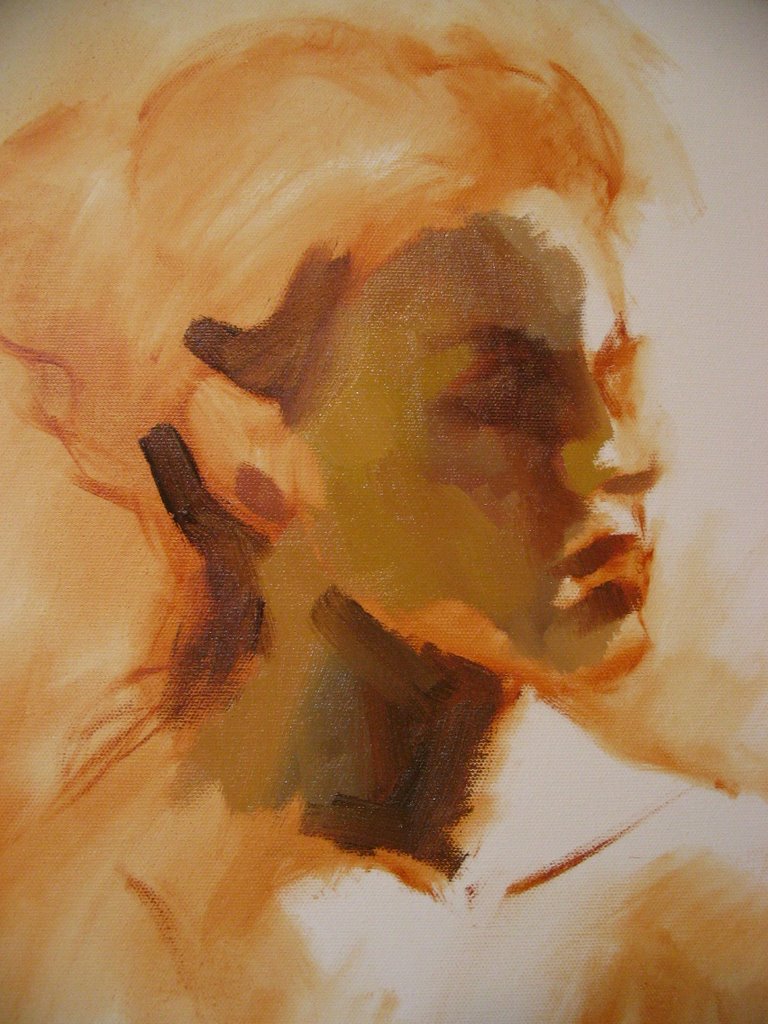
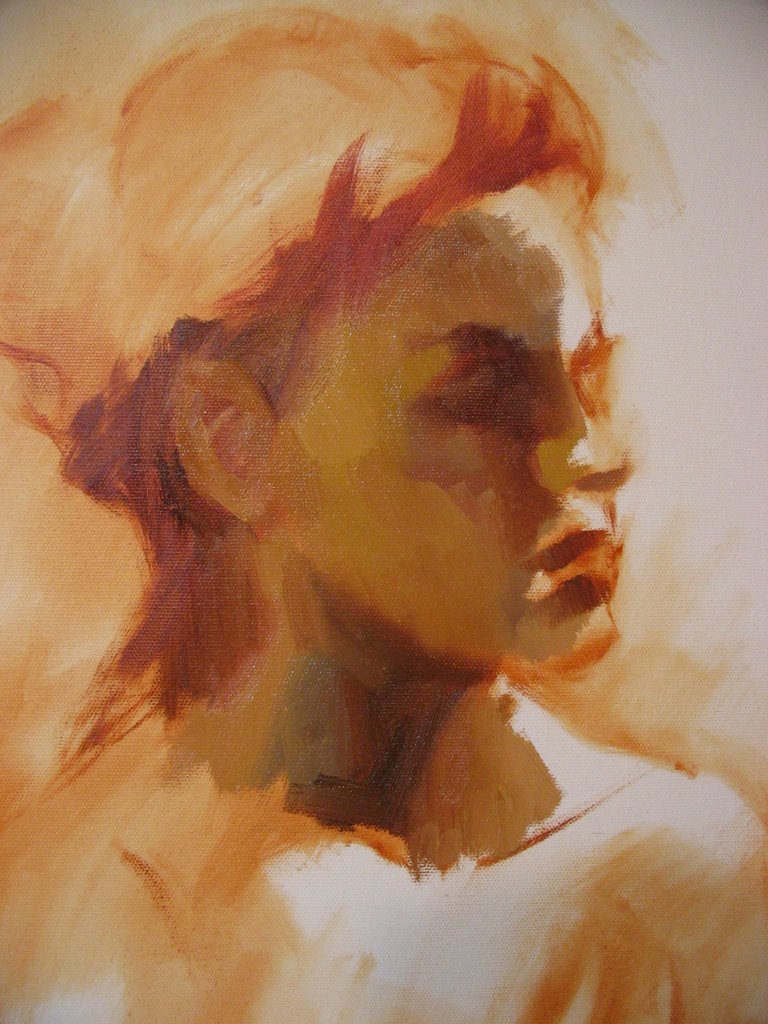
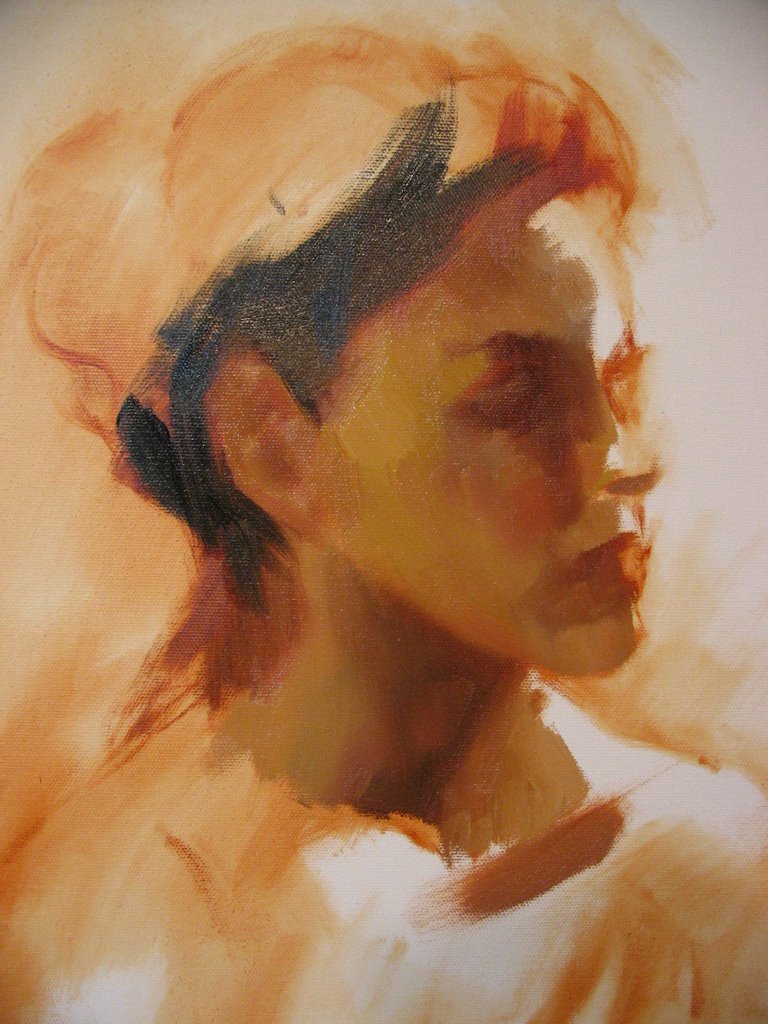
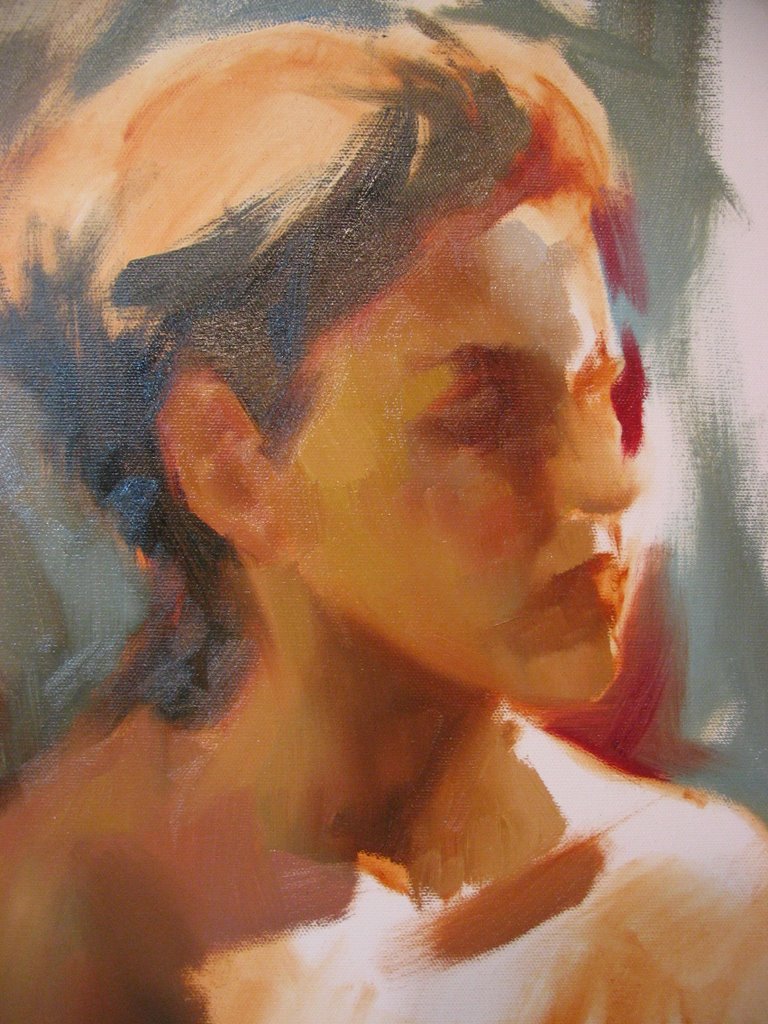
I photographed each stage and wanted to share them with those of you who love the way oilpaint can communicate flesh, depth and light. For artists, this kind of painting experience is akin to savoring a meal, enjoying taste after taste. It is also like meditating on music, focusing on the way each note relates to the overall impact upon a listener's nervous system. Done in the privacy of a studio, painting can feel relaxing or even painstakingly controlled. But performed in front of a crowd as an instructional process while speaking, a certain directness must rule. Add to that the strict time limit of two hours, and the experience becomes heart pounding.


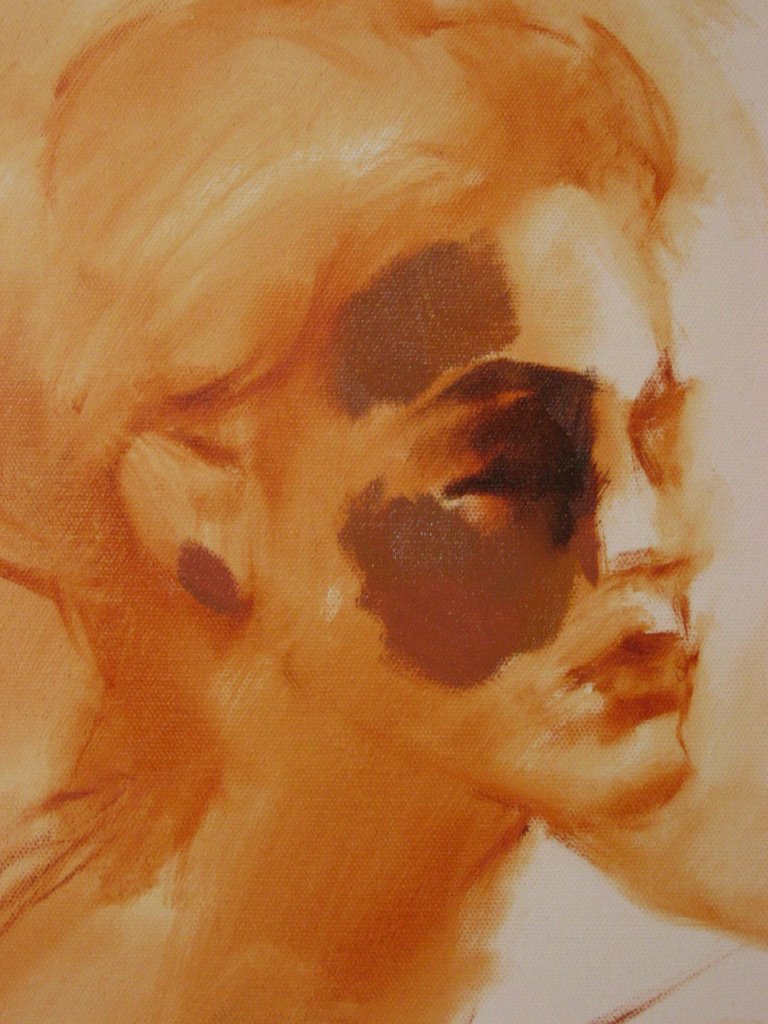
I had Toni, one of the top figure models in Los Angeles pose for me. Afer laying in a transparent wash of alizarin crimson, yellow ochre and a touch of ivory black, I began a loose drawing with a brush focusing on large proportions and structure. Because I will be painting with big shapes and masses of color, the drawing does not need to be refined. In fact, a precise drawing would create a different kind of painting experience for me, forcing me to tiptoe around the portrait. About ten minutes was spent on the drawing here, with me describing every observation.

For my palette I am using only four tubes of paint: Alizarin Crimson, Yellow Ochre, Ivory Black and Titanium White Classico Oil Paint.I am using a big #12 Brush.


I begin with what I consider the most difficult passage in the portrait: the eye-socket in shadow. Dealing with these darks and middle valued areas will help me create the large masses that carry much of the image. I save the lights for last, leaving the canvas blank in these aresa until I am ready for them. The beginning stages of laying in my big shapes is always a rush for me. The painting always appears strange to my eye, but in my mind I can visualize the final outcome even from these early few strokes of paint. As I squint, each area on Toni's face is carefully observed, related to an adjacent value and translated by me as a plane. Each plane is then translated as a brushstroke.


It's been about fifteen minutes of painting, and the audience (and I) all breathe a sigh of relief... The hardest passages are done. I can continue with confidence that the overall structure is working, and that the delicate reflective light is being communicated. Notice how the features are not detailed in any way at this stage.


Now I boldly lay in the darks of the hair, and paint the way the hair relates to the darkness of the background. As I do this, the audience gives a collective "Ahhh!"
The darkness causes the reflective light on the face to take on it's luminous character. The face is primarilly middle value!


Time for a ten minute break. The model stretches and I prepare for the next sitting. Total painting time so far: thirty minutes.


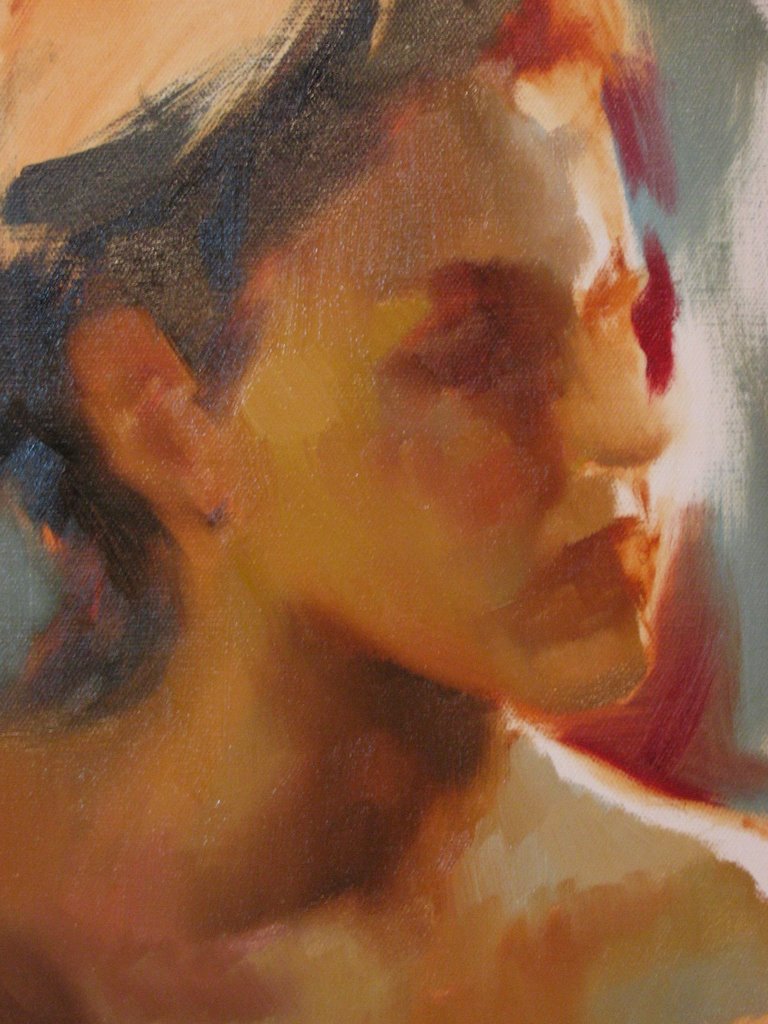
More airy background and a burst of alizarin crimson to enliven the glow of the light hitting the far side of the face. I do not sense a cut out hard-edged contour back there...

I am a Venetian painter at heart when I paint this way. Washes, unrefined passages, free color effects and varied edges are my choices.


I develop the chest and neck area...
The "greens" in the flesh are actually yellow ochre, black and white.
The "blues" in the background are actually just mixtures of black and white.


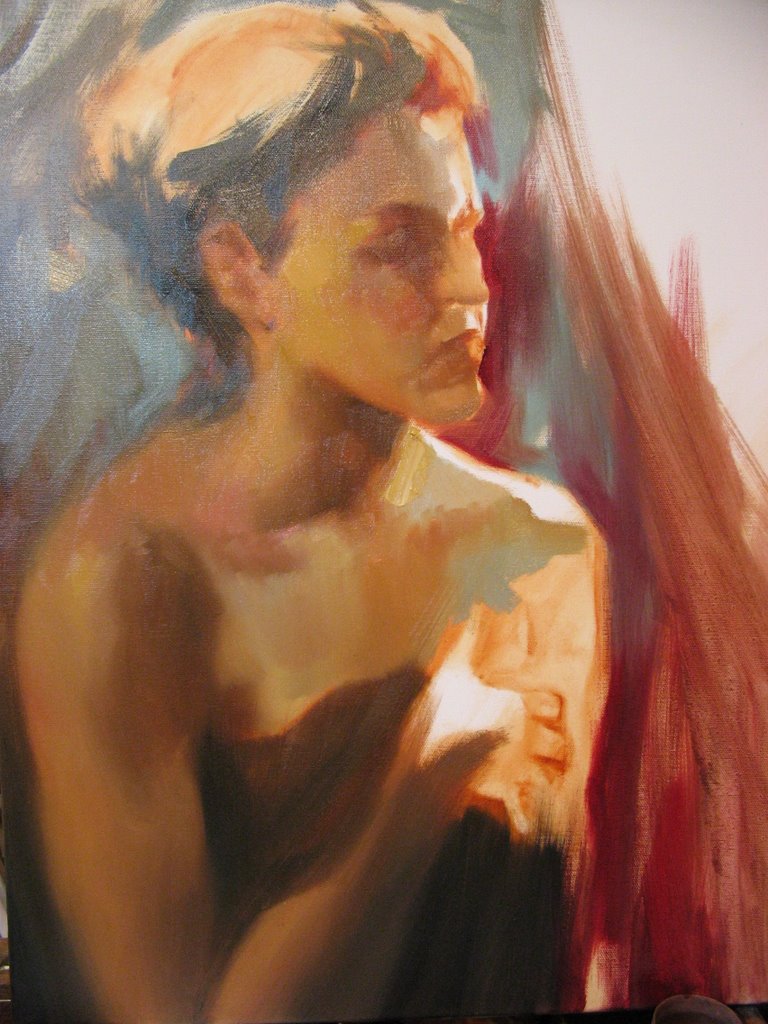
Time to move throughout the rest of the painting...and then return to the face to give her complexity and definition. The background, the hair, the arm, dress and expressive hand all develop quickly and simply. The blending of edges is very important. As you can see, I use precious few hard edges in my work. Finally everything begins to "fuse" as the unified image I intended.


Near the end, I address the drawing one final time. (Every stroke is "drawing"), but now it's time to pull out a smaller brush and be precise where needed. I carefully reshape the chin ...


I create the hand with masses and shapes. Then, with a few dashes of line, fingers are suggested. I let the thumb merge into the chest to keep the area from getting too liney. I have fun with the diminishing pinky. The dress and the anatomy of the arm come with refinement from a small brush.

Only now do I prepare for the adding of the lights.


This thin strip along the far side of the face is my true focal point, the area of clarity. A combination of crisp strokes floating in a soft haze of light will create depth, suggest the features and remain consistent with the rest of the painting. My goal here is to not impress the viewer with how much work I have done, but rather, how much work I refrained from doing to create her expression and sense of life.


[In the Light by John Paul Thornton]


After describing every stroke and subtle smear, I finish with a final highlight on her eyelid. My patient audience cheers. I wipe the sweat from my own brow. It's been two hours from the initial laying down of my wash. I sign the painting. Time for a beer.