Thursday, November 23, 2006

Rattle


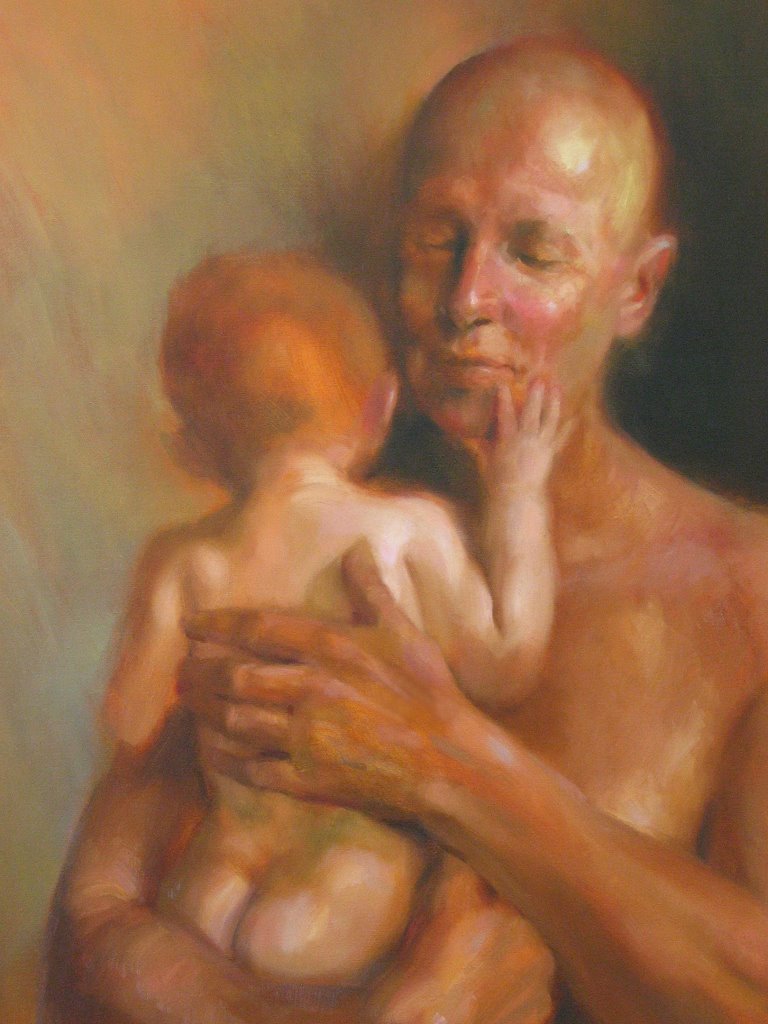
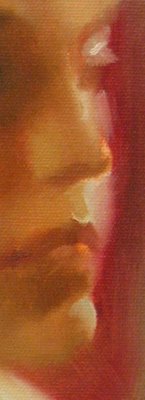
One of the most meaningful sights I have seen with my eyes, has been my father holding my daughter tenderly in his arms. My father is a gentle, complex man who has recently been battling cancer. My daughter is a radiant child full of affection and vigour.

While art history is packed with paintings depicting mothers and their children, the image of a man holding a small infant remains rare. To experience this interaction, to have it signify for me not only a vital part of my own life, but a rich reference to the life of any man who has held a delicate child, gives full power to the human figure as a symbol of spiritual signifigance and a subject without equal in my painting.

To attempt to conceptualize this image, or to abstract it into something that reflects less than it's direct impact upon my heart would be deceitful and self consciously apologetic.

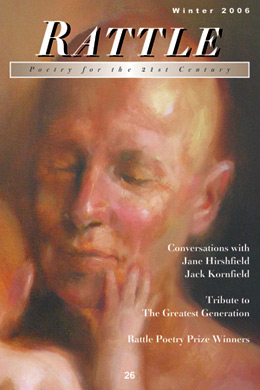
I am proud that my painting has been featured as the Fall 2006 cover of "Rattle- Poetry for the 21st Century" published by The Frieda C. Fox Family Foundation.


The image used is actually a detail of a full-sized portrait, which is shown in the book as well along with additional original paintings. I was very pleased to receive an advance copy of the book, and I must say that the printing is gorgeous and the poetry in the book's pages (written by poets from around the country) is thoughtful and intimate. I am very proud of the end results and grateful to all who thought of me as a contributing artist.

Information on how to order this book can be found by clicking on this link.


Here is the featured portion of the full painting called "Grandpa's Cure".

Wednesday, November 22, 2006

Flesh and Luminosity


Earlier this year I did a portrait demonstration for an audience of about fifty people at the Fine Artists Factory in Pasadena, California.

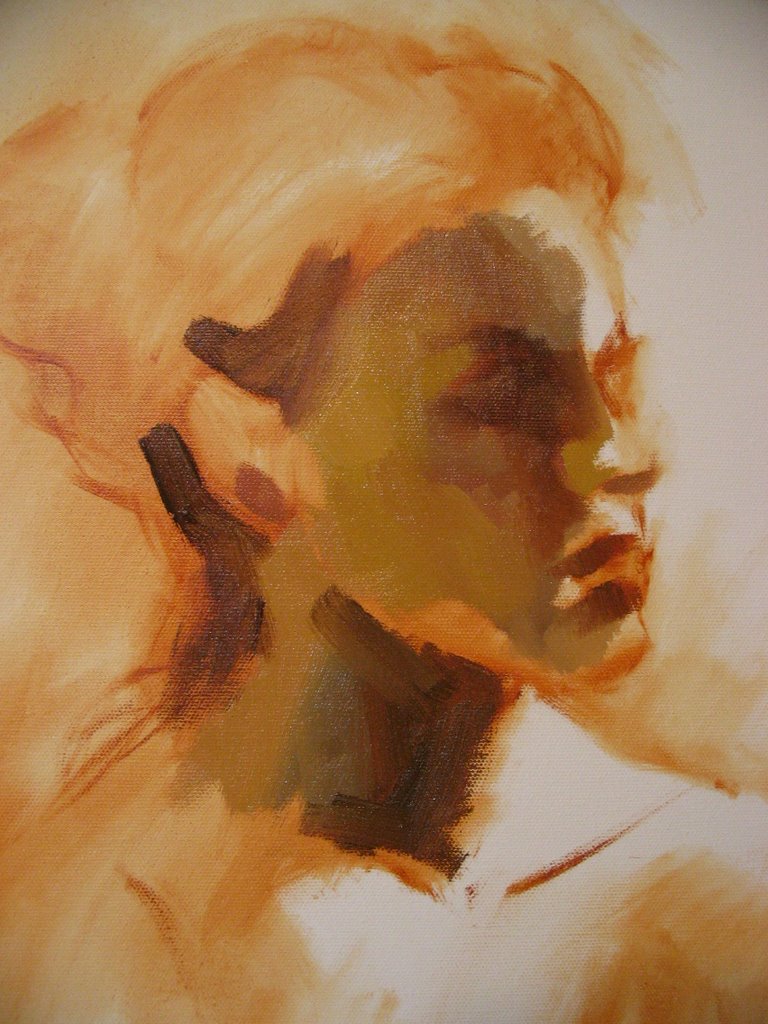
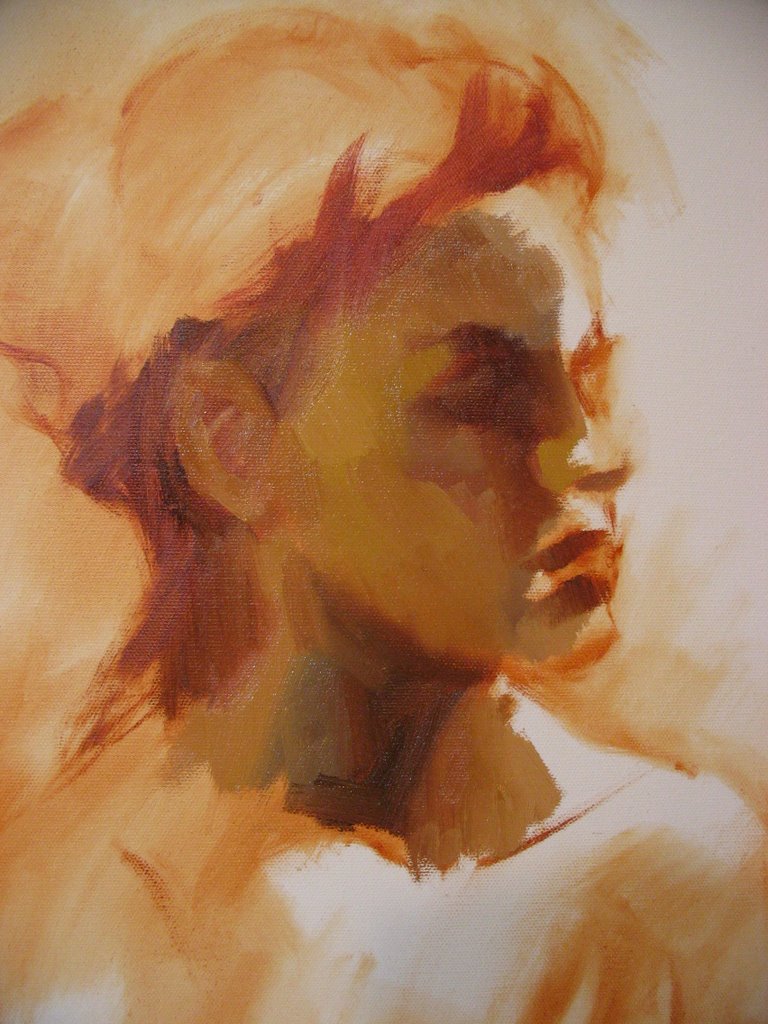
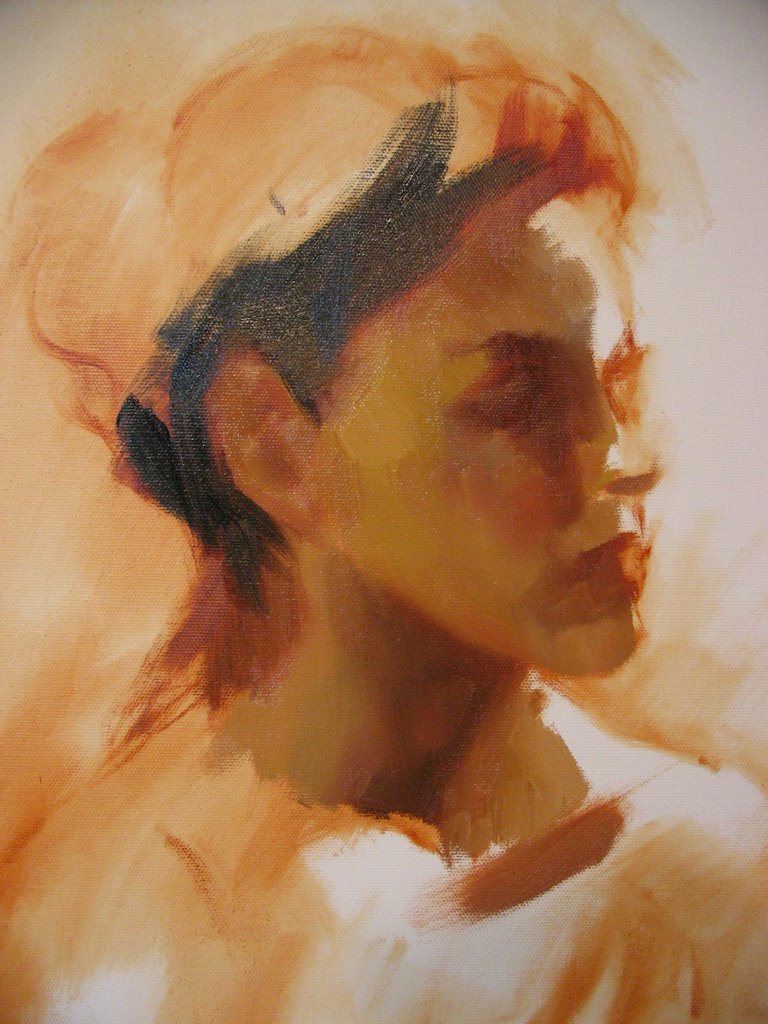
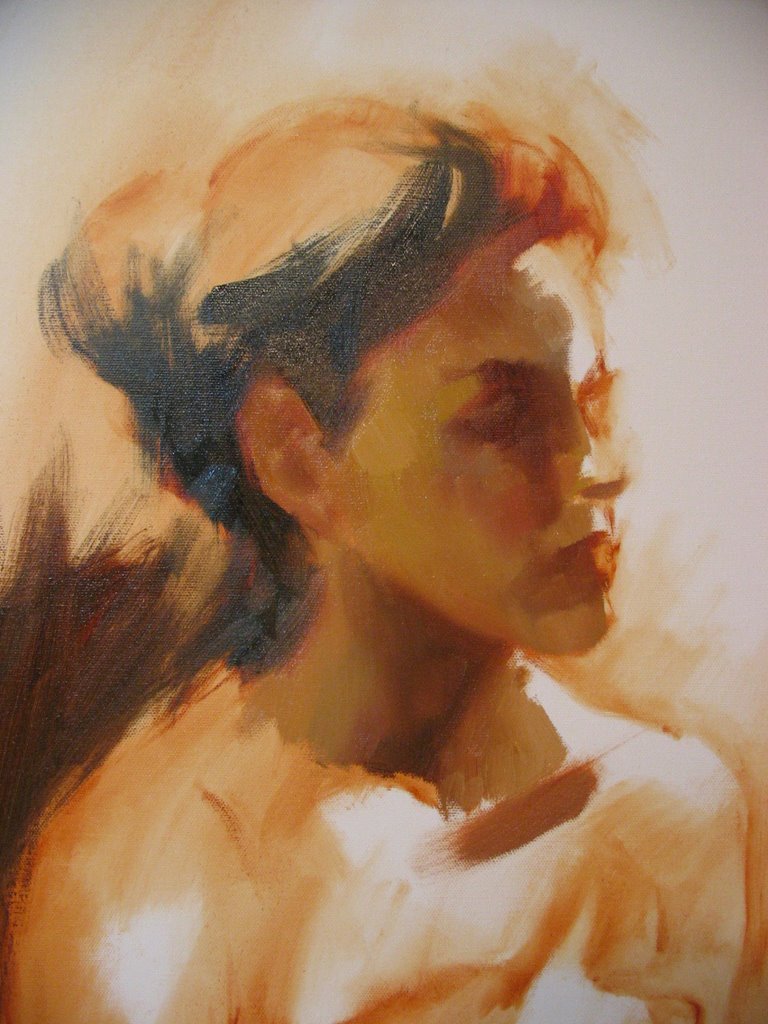
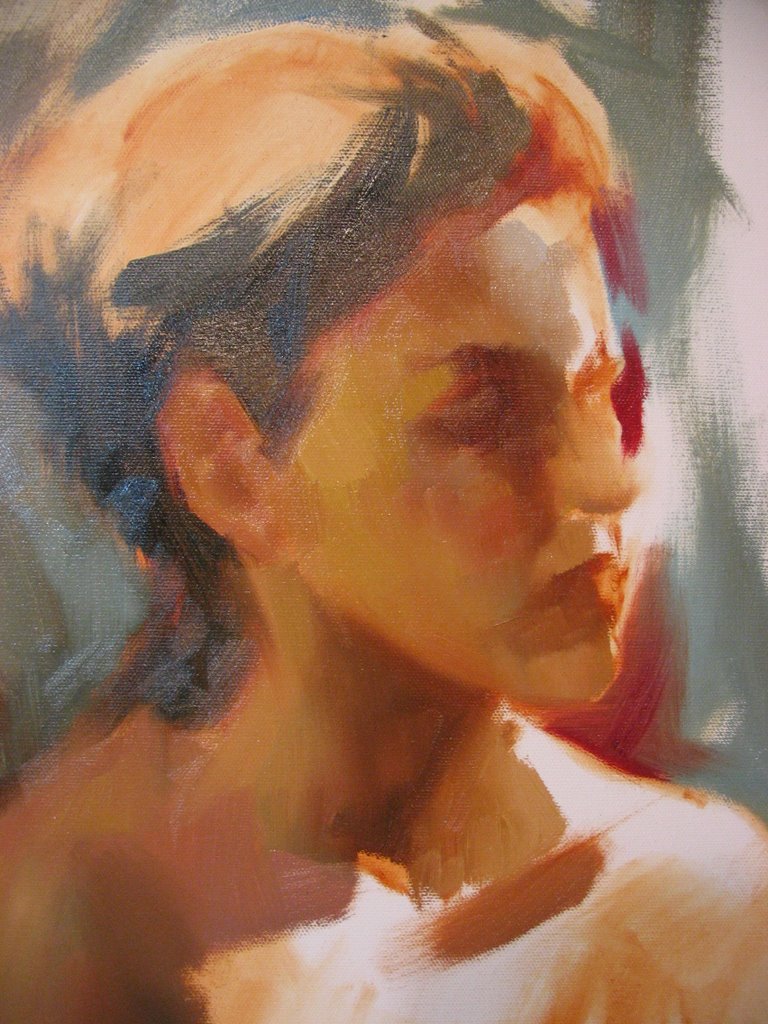
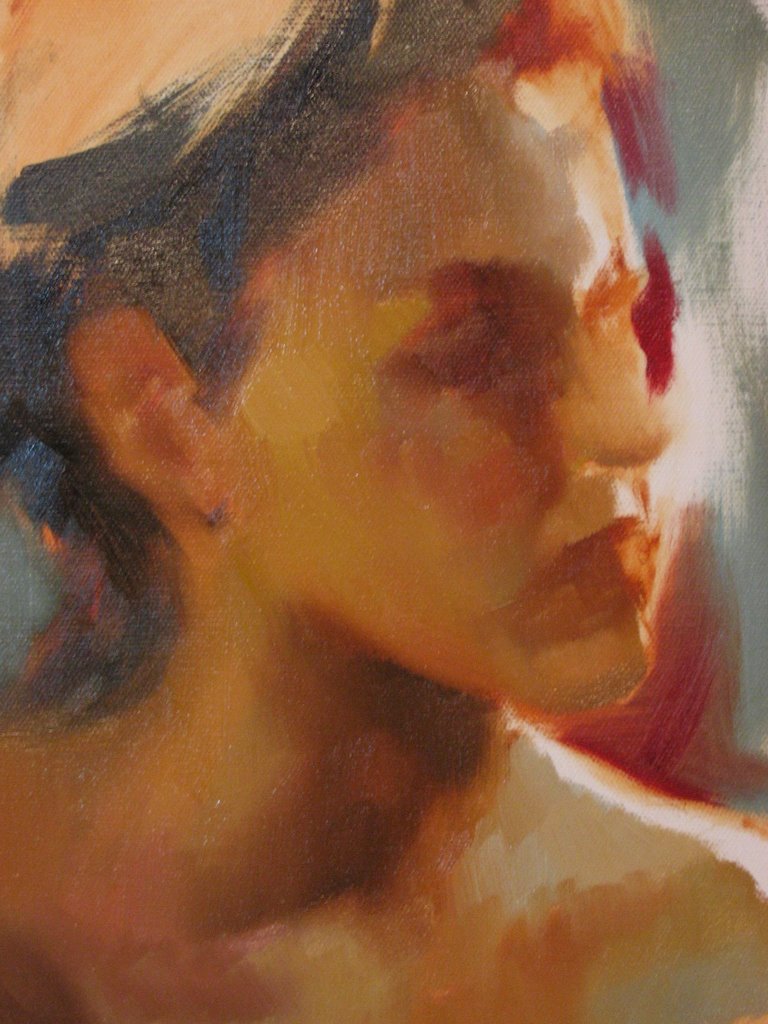
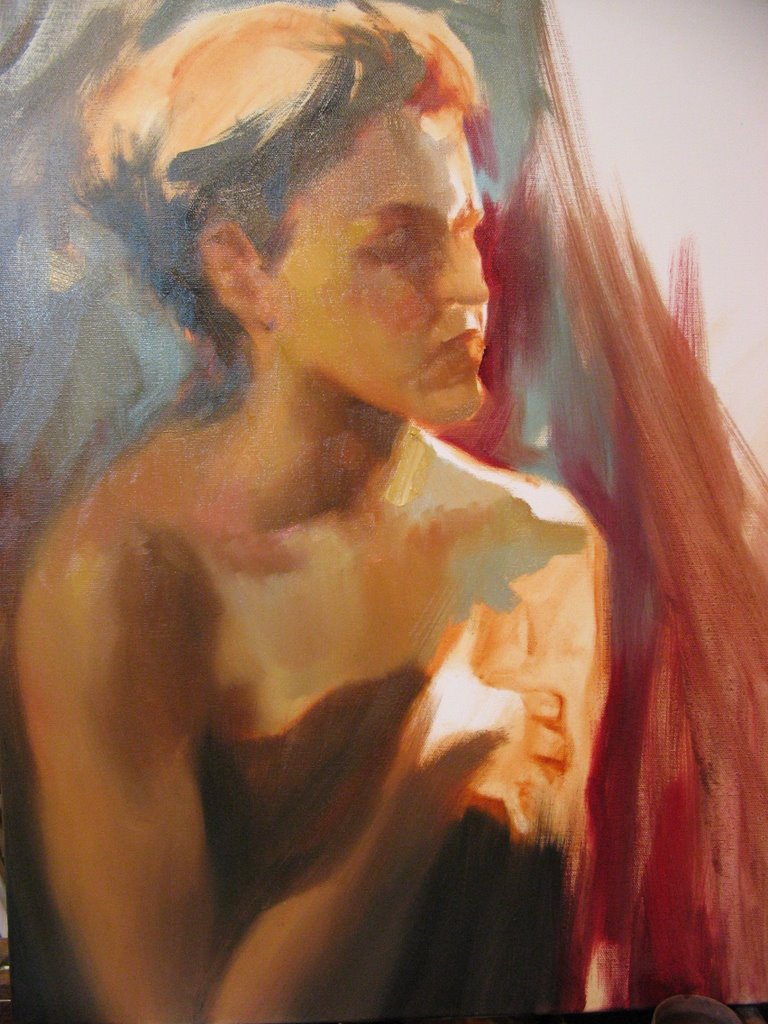
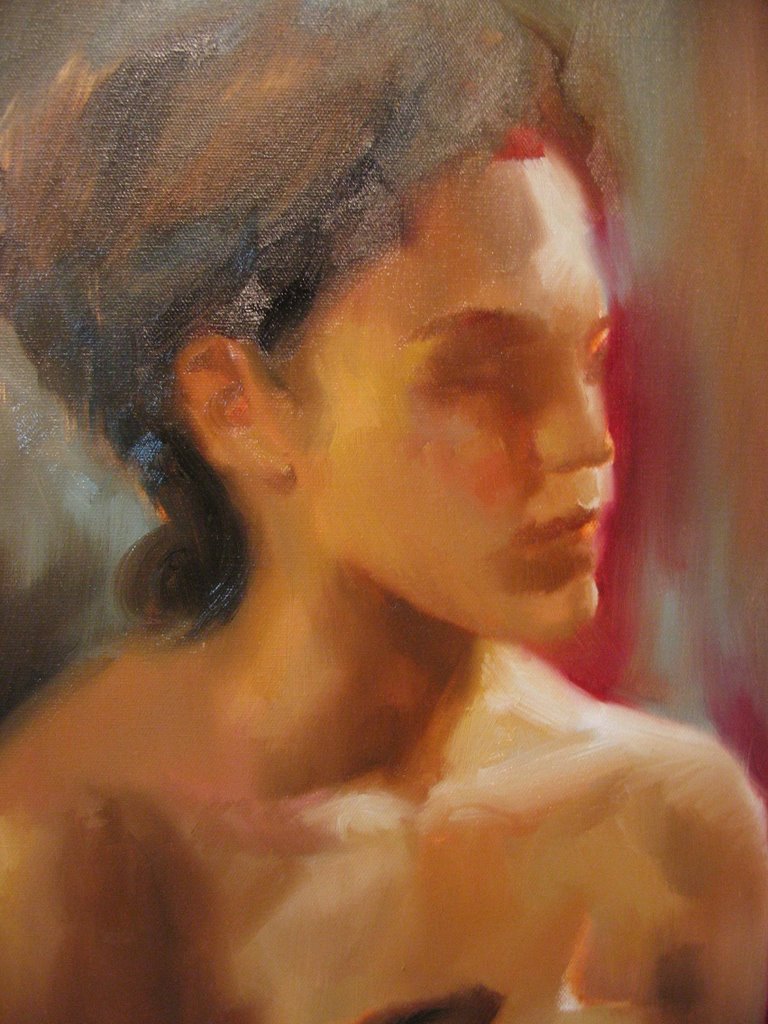
I photographed each stage and wanted to share them with those of you who love the way oilpaint can communicate flesh, depth and light. For artists, this kind of painting experience is akin to savoring a meal, enjoying taste after taste. It is also like meditating on music, focusing on the way each note relates to the overall impact upon a listener's nervous system. Done in the privacy of a studio, painting can feel relaxing or even painstakingly controlled. But performed in front of a crowd as an instructional process while speaking, a certain directness must rule. Add to that the strict time limit of two hours, and the experience becomes heart pounding.


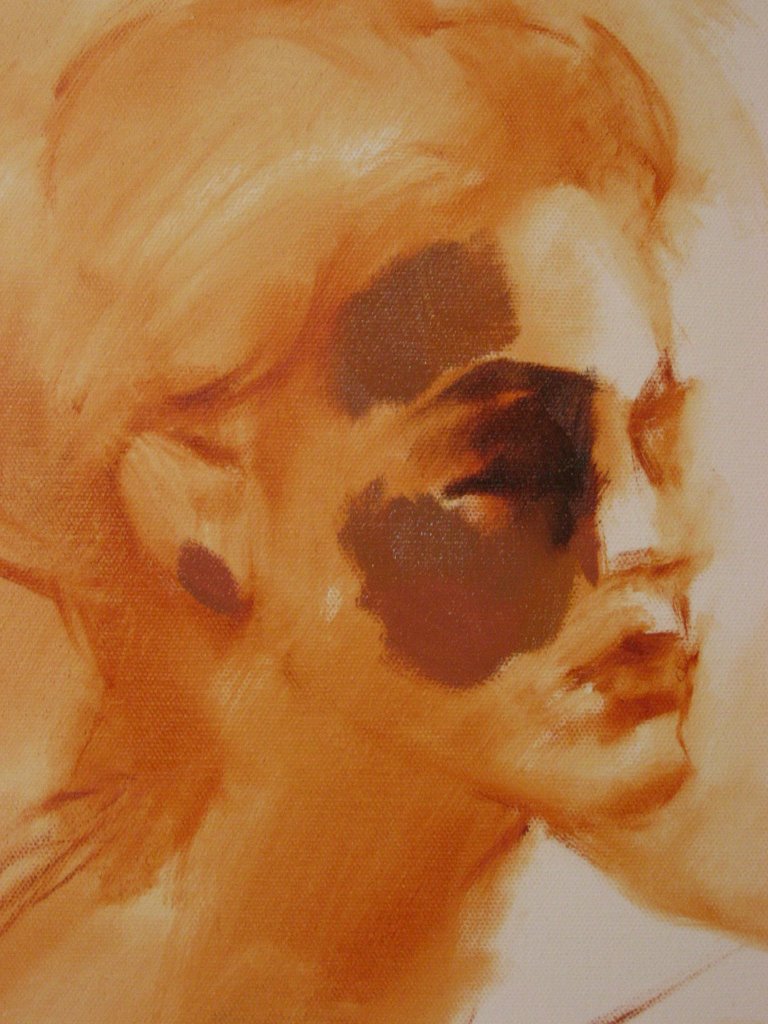
I had Toni, one of the top figure models in Los Angeles pose for me. Afer laying in a transparent wash of alizarin crimson, yellow ochre and a touch of ivory black, I began a loose drawing with a brush focusing on large proportions and structure. Because I will be painting with big shapes and masses of color, the drawing does not need to be refined. In fact, a precise drawing would create a different kind of painting experience for me, forcing me to tiptoe around the portrait. About ten minutes was spent on the drawing here, with me describing every observation.

For my palette I am using only four tubes of paint: Alizarin Crimson, Yellow Ochre, Ivory Black and Titanium White Classico Oil Paint.I am using a big #12 Brush.


I begin with what I consider the most difficult passage in the portrait: the eye-socket in shadow. Dealing with these darks and middle valued areas will help me create the large masses that carry much of the image. I save the lights for last, leaving the canvas blank in these aresa until I am ready for them. The beginning stages of laying in my big shapes is always a rush for me. The painting always appears strange to my eye, but in my mind I can visualize the final outcome even from these early few strokes of paint. As I squint, each area on Toni's face is carefully observed, related to an adjacent value and translated by me as a plane. Each plane is then translated as a brushstroke.


It's been about fifteen minutes of painting, and the audience (and I) all breathe a sigh of relief... The hardest passages are done. I can continue with confidence that the overall structure is working, and that the delicate reflective light is being communicated. Notice how the features are not detailed in any way at this stage.


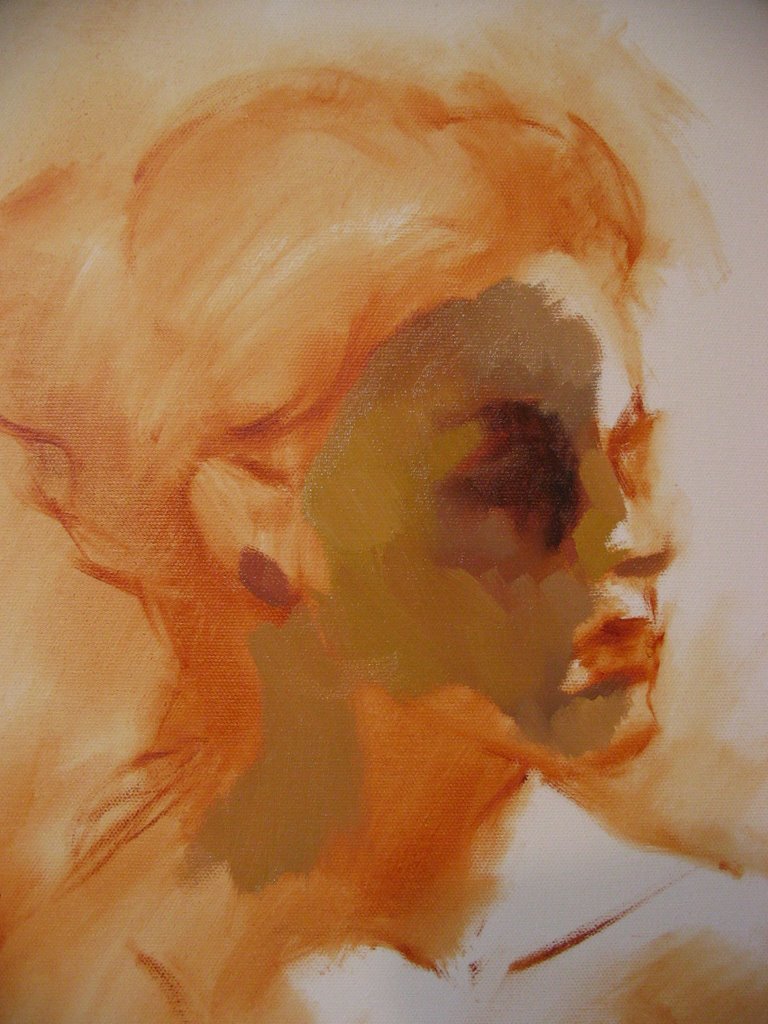
Now I boldly lay in the darks of the hair, and paint the way the hair relates to the darkness of the background. As I do this, the audience gives a collective "Ahhh!"
The darkness causes the reflective light on the face to take on it's luminous character. The face is primarilly middle value!
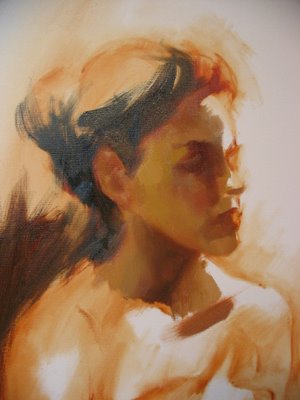


Time for a ten minute break. The model stretches and I prepare for the next sitting. Total painting time so far: thirty minutes.


More airy background and a burst of alizarin crimson to enliven the glow of the light hitting the far side of the face. I do not sense a cut out hard-edged contour back there...

I am a Venetian painter at heart when I paint this way. Washes, unrefined passages, free color effects and varied edges are my choices.


I develop the chest and neck area...
The "greens" in the flesh are actually yellow ochre, black and white.
The "blues" in the background are actually just mixtures of black and white.


Time to move throughout the rest of the painting...and then return to the face to give her complexity and definition. The background, the hair, the arm, dress and expressive hand all develop quickly and simply. The blending of edges is very important. As you can see, I use precious few hard edges in my work. Finally everything begins to "fuse" as the unified image I intended.


Near the end, I address the drawing one final time. (Every stroke is "drawing"), but now it's time to pull out a smaller brush and be precise where needed. I carefully reshape the chin ...


I create the hand with masses and shapes. Then, with a few dashes of line, fingers are suggested. I let the thumb merge into the chest to keep the area from getting too liney. I have fun with the diminishing pinky. The dress and the anatomy of the arm come with refinement from a small brush.

Only now do I prepare for the adding of the lights.
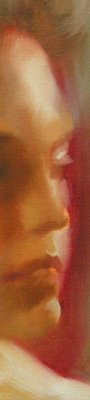


This thin strip along the far side of the face is my true focal point, the area of clarity. A combination of crisp strokes floating in a soft haze of light will create depth, suggest the features and remain consistent with the rest of the painting. My goal here is to not impress the viewer with how much work I have done, but rather, how much work I refrained from doing to create her expression and sense of life.


[In the Light by John Paul Thornton]


After describing every stroke and subtle smear, I finish with a final highlight on her eyelid. My patient audience cheers. I wipe the sweat from my own brow. It's been two hours from the initial laying down of my wash. I sign the painting. Time for a beer.

Sunday, October 15, 2006

The Spirit of Children


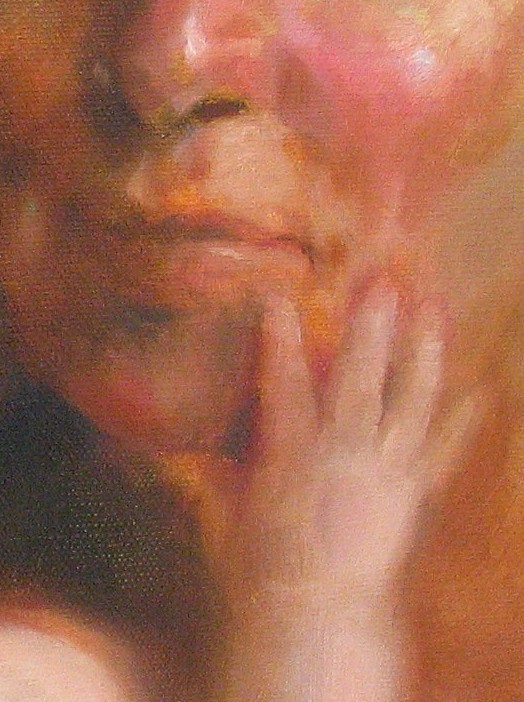
["Where To Now?" By David Andres Kietzman]


Visitors entering the gallery at Avenue 50 Studio in Highland Park, Los Angeles, were met with a space lit with candles and decorated with vases of marigolds. Groups slowly moved from piece to piece, or lingered to absorb the unapologetically heavy content.
An art show about remembering the souls of dead children? Most gallery directors would never approach such a theme for purely commercial reasons. Others might try but would instead produce a show laden with treacle, diverting the viewer from responses deeper and more constructive than tears and grief.

Kathy Mas-Gallegos is the well-known Director of Avenue 50 studio. She has approached this difficult theme with dignity, poetry and dry-eyed honesty, currating an exhibition that relates to the Mexican celebration of Dias De Los Muertos while providing social reflection and urgency. Ten artists were asked to produce work that commemorates, celebrates or mourns children and youth who have died an untimely death due to preventable disease, gang violence, abuse, and/or war. Ultimately this is an emotionally wrenching show.


The full name of the exhibition is "Miccailhuitontli - Spirit of the Children."

Say "Mick-Hail-Wheat-Tont-Lee", and you are pronouncing a word that dates from Aztec times. As Director of Avenue 50 Studio, Kathy Mas-Gallegos posted this descriptive statement about the theme of the show and it's origins:

"“Miccailhuitontli -— Spirit of the Children, a Mejica traditional celebration of DiŒa de los Angelitos.
According to the system of beliefs in deities particularly of the Mejica Aztecs, gods ruled parts of the earth, heavens and underground. Along with this, there were times during the year at which they honored these gods or the people they served. Miccailhuitontli represents a period of time in which deceased children were held in reverence. Miccailhuitontli was presided over by the goddess Mictecacihuatl, lady of the dead.

Eventually under the rule of the Spanish, Mejica tradition gave way to what we now know as the ceremonies of the days of the dead. In Mexico today, as perhaps in other parts of the world, there is a day to mourn and honor deceased children, as there is a day to mourn and honor deceased adults.
As the tradition goes in Mexico, paths are strewn with marigold petals leading to the house of the deceased child so that the soul can find its way back to its home and mingle once again, through spirit, with friends and loved ones.

As malevolent conditions in our world intensify, affecting the spirit and consciousness of our children - our future - is being destroyed. We honor these fallen children by bringing to the forefront those conditions that have wrought havoc in their young lives: war, gang violence, hatred, abuse, and preventable disease. We honor these fallen children in the hope that someone, or two or three, will hear and understand that only through determined action will crimes against children significantly decrease."


I was invited to contribute works, along with Edith and Rob Abeyta, Roberto L. Delgado, Kathi Flood, Clement Hanami, David Andreˆs Kietzman, Betsy Lohrer Hall, Ricardo Munoz, and Mark Vallen.

Betsy Lohrer Hall Dominates a main wall with what appears at first to be the installation of a shower of leaves, or many hanging branches of a weeping willow. Her "Lost and Missing Tree" is actually hundreds of squares of paper. Upon each the artist has hand-written the individual names, ages and causes of death of Iraqi children whose lives were taken during the last few years during warfare. Adding beauty and further heartbreak, the backs of each scrap are printed with designs borrowed from artworks looted from the Baghdad National Museum. The work speaks elloquently about the idea of loss...loss of a generation and of a culture. There is an inescapable connection that Hall had made with each of the names. The papers they are hand-written on are like little post-it notes...They are little reminders we make to ourselves about items we need desperately to remember.

Mark Vallen presents "Child Of War", an intimate work which hinges greatly upon precision and delicacy. As a realist painter, he unerringly depicts a single face of a young boy bearing an expression of fatigue, betrayal and spiritual damage. Vallen's "Child of War" could belong to dozens of cultures, but the artist's timely statement reminds viewers about the specifically incomprehensible civilian death toll mounting in the Iraqi War. Mark Vallen's choice to create a painting in his polished traditional style (reflecting an admiration of Renaissance masters) provides the viewer no escape from the dedication and proficiency of the artist's hand or intent. Indeed, to linger so sensitively over the subtle value changes of the boy's nostril, cheek and lips implies a deliberateness that casual sketchiness cannot compete with. Thus, the boy is given the same respect that might have been lavished upon the portrait of a young royal Duke at the hands of fourteenth century German painter Albrect Durer. Questions of worthiness and status are cast aside.

Kathi Flood has offered a work honoring the soul of a young local boy who was swept away by storm waters. Through text, we learn that his rescue was hindered by the lack of effective equiptment by authorities. It was only through his loss that proper poles and extention devices came into use. The playful appearance of the installation disolves as viewers are coaxed to recall their own memories of rescues caught on home video which top breathless news reports each winter.


["Portrait of a missing child" By John Paul Thornton]


As for my own offering,I included five portraits of missing children, along with the disposable "Have You Seen Me?" mailers that inspired them. I too find that my somewhat obsessive continuation of this body of work, (I have created nearly four hundred painted portraits of America's missing children) reflects a kind of compulsive devotion which links the ten artists in the show together. Thank you to the many viewers I met at the opening night who were moved by my work. Thank you also to Kathy Mas-Gallegos, the Director of Highland Park's Avenue 50 Studio for this show about art and courage.

Tuesday, October 03, 2006

Messages From Another Time


The spine of the old book was tattered, thick and covered with bold words:

“NOB U Delima Likovnih Umetnika Jugoslavije”

I had to climb a ladder to retrieve it from the top shelf of the art section in a favorite used book store I frequent every time I’m in Hollywood. Some people go to health spas, or meditation retreats, or brothels. I go to used book shops. They are like temples to me.

Over the years I have obsessively developed a juicy art book collection containing an especially gorgeous array of rare folios on painting and drawing. I believe I have a keen sense about a book even from the look of it’s spine, and I still get a primitive thrill from the simple act of discovering such a book, especially when it is stuck high above my head on a shelf nine feet from the floor. There is a sense of locating a missing friend, or finding a piece of humanity’s great puzzle. This is my compulsion.

When the book was finally in my hands, I took in the feel of the worn canvas cover, the heavy water damage and even the aura of the book itself. ( Yes, books have auras.) Then I read the title on the spine again:

“NOB U Delima Likovnik Umetnika Jugoslavije.”

I opened the first pages, and found them all to be printed in what seemed to be...Yugoslavian. The publishing date was 1958. Like someone savoring the slow opening of a wrapped present, I thumbed past the text to the plates. What met me was image after image of human suffering, and strength in the face of dispair. I stood in the bookshop aisle for ten minutes, returning to the beginning page and assessing the prints with admiration and care. Paintings and sculptures of wounded soldiers, old women in kerchiefs, torn landscapes and huddled children filled the pages, affecting me with so many intense emotions. I had not expected this. The intimacy and often hurried appearance of the drawings gave testament to the fact that many of the works featured within the yellowed paged were dated 1942 through 1945. Obviously these were images created during the second world war.

Ah, I see you have found the book,” said the grizzled shopkeeper. He had been watching me carefully. “It takes a special someone to appreciate that one, and I have seen hundreds of people just flip through it’s pages and then jam it back in the shelf. But not you. You cannot put down.” He came around the counter and put on a pair of glasses that had been hanging from a tarnished chain around his fleshy neck.

I told him that I thought the book was incredible, and asked if he could give me some background about it.

“I think it translates as 'Yugoslavian painters and sculptors reflecting on the struggle of world war two'. It‘s a difficult book. Such images of sadness...and it‘s all still happening today, you know. You can still see these images on CNN. Sixty years have passed, and we are still learning this, over and over. Different countries, different people, same lesson. ”

For a third time, I flipped through the pages, while the two of us commented or drew a heavy breath at the sight of each of the two hundred and seventy paintings, sculptures and sketches from almost a hundred artists. Many of them dated from the height of the war years and seemed to have been drawn from actual observed scenes. Mesmorized, I bought the book.

I think of these artists as time travelers, sending their messages to our twenty-first century as a way of warning us, or at least linking us, to their own time of darkness and hope. The old book could be our own, and the words on the spine could be printed in countless languages.

I have included images taken from this remarkable find. I was distressed to think that these artist’s expressions were all but lost to the world, and that if the book had been neglected by me or had been ultimately discarded, the recording of their visions and feelings would be lost as well. When I purchased the book, it was for the memory of these artists, and to the communities and families that they depicted. They are us. They are the images of our own soldiers and mothers, children and grandparents.

These images may move you in their bleakness, or inspire you by their authenticity. They were made by forgotten Yugoslavian artists who would not close their eyes at what they saw. They did not ignore what they felt. They talk to us now, from across time.


Take a moment to read about The Country and People of Yugoslavia.
All Images in this post are from "NOB U Delima Likovnih Umetnika Jugoslavije" Published in Belgrade, 1958

Tuesday, August 29, 2006

Tommy Hollenstein- Dancing with Color

Tommy Hollenstein’s paintings are alive with color. Vibrant reds and rich blues collide with streaks of yellow like veins of energy. Colors like sunsets or lush abstract landscapes radiate seductively. Some canvases are elegantly stark, while others are dense with layers and rhythm. It’s the rhythm that is captivating. Evoking movement is the painter’s greatest challenge, for the picture is in reality motionless before us. It is the skill and passion of the artist that can cause the surface to appear to dance. Once the viewer is captivated by the dance on the canvas, they are lured closer to inspect the strokes on the surface. With Tommy’s art they will find no brushstrokes at all. There is something else: Patterns laced within patterns and spirals of swirling tire tread-marks. Tommy Hollenstein paints with his wheelchair.

Our culture easily embraces the victim, but Tommy has nothing to offer in the victim-hood department. Instead, he concentrates on his powerful strength and gifts. Without a pause he will tell you that his art is about “Joy and passion.”

Charismatic and handsome, he does not hesitate to talk about the day when at age twenty five, he broke his spinal column in a bike accident that changed his life forever. On March 10th, 1985 when he flew off his bike and hit the ground, he remembered hearing a “pop” like the striking of a metal rod. Then, he remembered floating up into the clouds.

“I was dead”, he says. “I could look down and see my own body laying there motionless. I remember thinking that I was not yet ready to die. I asked God to give me another chance.” When Tommy returned to his body, he knew immediately that he had broken his neck. His buddy called an ambulance, and the seriousness of his injury was confirmed. When he arrived at the hospital a priest gave him his last rights, but Tommy’s gratitude for life surpassed his sense of loss, and he did not die. After six difficult months in rehab, he was able to get movement in his arms and learned how to function as a paraplegic. Tommy would spend his remaining life in a wheelchair.

Of course, being the amazing person that he was, after being discharged he immediately set about living his life to the fullest. Without the use of his legs, he still enjoyed boating and water-skiing. His interest in this dynamic sport led him to even create a special device that Quadraplegics now use to water-ski. This kind of love for other people ensured that he would always be active and social. To be sure, Tommy was not alone in the world. His ongoing journey was enhanced greatly over the ensuing years by physical therapists, family and friends… and also by a dog named Weaver. Weaver was trained specifically to aid Tommy and grew to become his trusted companion. It was through this special relationship that Tommy was led to realize his powerful voice as an artist.

Tommy speaks with emotion as he relates the idea that opened this door. “I knew that my dog wouldn’t always be in good health forever. I wanted to do something to remember Weaver by. Why not record his paw-prints?” He laid a flat surface on the ground in his garage and coaxed Weaver to dip his paws in colored house paint. Then, Tommy rolled through some paint as well.He moved across the flat surfacein his wheelchair as Weaver walked faithfully beside him, leaving paw prints and tire marks on the paper. They tried this together a few times, and during the process Tommy realized that now...he was painting.


“ I tried experimenting with different colors, and patterns. I found that I had really fine control over the sensitivity of my marks,” he states. Indeed, the built-in computer in his wonderful Invacare motorized wheelchair allows him to maneuver with varying speed, direction and pressure as he paints. He was hooked.
A number of dedicated paraplegic and quadriplegic artists around the world have learned to paint with brushes delicately held by their teeth, or with their toes. Their work is incredible in that it is a testament to unstoppable courage , but it also reflects the common drive that so many artists have within them. Learning or relearning a manual dexterous skill is simply part of the path for the dedicated artist, who will not let their creativity be hindered in any way. There are inspiring stories of the French Impressionist painter Renoir asking assistants to tie paint brushes onto his crippled hands with rope when he could no longer hold them. Old photos attest to that. This was how Renoir, also confined to a wheelchair, created his last shimmering paintings. Since the process of relearning skills was a regular part of Tommy’s lifestyle, he put no barriers up when the time came to develop his new way of approaching art-making.

“I feel free when I am painting in my wheelchair,” Tommy says. “I feel No restrictions.” Is it possible that by not relying on his limbs or hands, might his mind and his heart be more readily involved in the creation process? Watching Tommy “glide” over a canvas gives the impression that he is “flying” above his art. He leaves his tracks in paint, announcing without irony or self-pity that he is actually dancing.

Tommy Hollenstein’s first dog Weaver has passed on. His new dog Hiley now attends his crowded art exhibitions with him. Growing acknowledgment by the media helps get his paintings out in the public consciousness. His charity art projects with children help him spread the message of strength. “Do what you love. Have gratitude for life,” he says. God dealt Tommy a card that would challenge any of us. He responded to that card with art and courage.